


What is artificial intelligence (AI)?
Let's demystify artificial intelligence (AI): from its fundamental concepts to its real-world applications, learn how these incredible algorithms learn.
FUNDAMENTALSAI
Lucas GRANDIER
5/6/20265 min read


Artificial intelligence, often referred to as AI, has become one of the most important technologies in the modern world. Today, it is present almost everywhere around us, even though many people don’t always realize it. It can be found in smartphones, search engines, social media, streaming platforms, and machine translation tools.
So, what exactly is artificial intelligence ?
A simple definition of artificial intelligence
Artificial intelligence refers to a set of technologies that enable a machine to replicate certain forms of human intelligence. This includes, for example, speech recognition, image analysis, language comprehension, and the ability to learn from past experiences.
The term was coined in 1956 by John McCarthy at a scientific conference on new computer technologies.
Since then, AI has evolved significantly thanks to advances in computer science, increased computing power, and access to digital data. Today, it is used in a wide variety of sectors, such as:
healthcare
finance
le marketing
education
transportation
e-commerce ...
Artificial intelligence does not completely replace humans, but it primarily automates certain complex or repetitive tasks to save time and improve efficiency.
How does artificial intelligence work?
To fully understand “What is artificial intelligence?”, it’s important to know how it works in simple terms. Contrary to popular belief, artificial intelligence does not “think” like a human. It operates using calculations, mathematical models, and a massive amount of data that enable it to learn over time.
The functioning of AI relies primarily on three key elements:
data
algorithms
machine learning
These three components work together to enable the machine to analyze information, recognize patterns, and provide increasingly accurate responses.
Data : The Foundation of Learning


Data is the foundation of all artificial intelligence. Without data, AI cannot learn or improve.
This data can take various forms :
images
text
videos
audio
numbers
The more information an AI receives, the better it becomes at recognizing certain patterns and improving its performance over time.
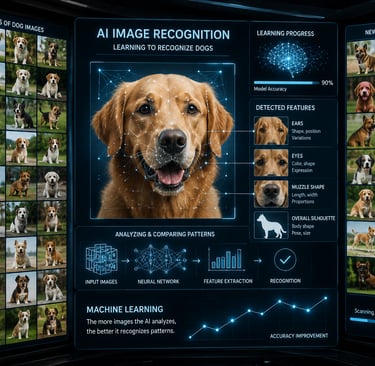
For example, if an AI system needs to learn to recognize a dog in a photo, it will have to analyze thousands, or even millions, of images featuring different dog breeds, colors, and angles. By comparing all these images, the AI eventually identifies certain common characteristics such as:
the ears
the eyes
the shape of the snout
the overall silhouette
It is precisely this principle that enables smartphones today to recognize faces and streaming platforms to recommend personalized content.

Algorithms : The Brain of AI
Once the data has been collected, it is processed by algorithms. An algorithm is a sequence of instructions that enables a machine to analyze information and make certain decisions.
Algorithms are generally used to :
compare data
detect patterns
classify information
predict certain outcomes
For example, when a platform like Netflix recommends a show to you, its algorithm analyzes :
what you watch
the time spent on certain content
your preferences
the habits of other users with similar tastes
Based on these calculations, the AI can then provide personalized recommendations.
Search engines also use algorithms to display the most relevant results when a user performs a search on the Internet.

Machine learning
Machine learning is one of the most important technologies in artificial intelligence.
Instead of being programmed for each specific situation, AI learns automatically from the data it receives. The more it trains, the more accurate its results become.
For example :
an email account gradually learns to detect spam
a voice assistant improves its voice recognition
a photo app becomes capable of recognizing objects or people
Machine learning therefore enables AI to continuously improve without direct human intervention.
Deep learning : an even more advanced form of AI
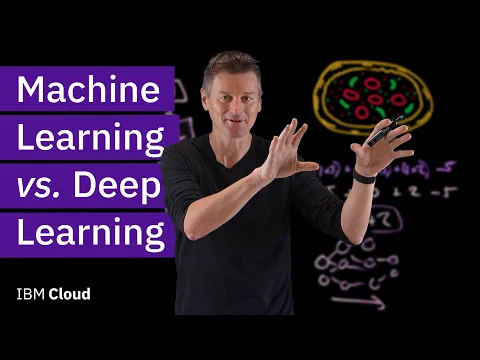
Deep learning is a more advanced form of machine learning. This technology uses artificial neural networks modeled after the functioning of the human brain.
Thanks to deep learning, some artificial intelligence systems can perform highly complex tasks such as:
facial recognition
machine translation
autonomous driving
the generation of text and images
It is this technology that now enables certain conversational AIs to understand complex questions and generate natural-sounding responses.


The Different Types of Artificial Intelligence
There are several categories of artificial intelligence, classified according to their capabilities and applications.
Narrow AI
Narrow AI is the most widely used form of AI today. It is specialized for a specific task and cannot function outside of that domain.
For example :
Siri responds to voice commands
Google Assistant helps users perform certain searches
Video platforms recommend personalized content
This AI is very powerful, but it lacks the consciousness or overall understanding that a human possesses.


Strong AI
Strong AI refers to a theoretical form of artificial intelligence capable of thinking, understanding, and reasoning exactly like a human being.
At present, this technology does not yet actually exist, although many researchers are working on increasingly advanced systems.


Generative AI
Generative AI is currently one of the most popular forms of artificial intelligence. It can automatically create:
text
images
videos
music
computer code
Modern platforms like OpenAI use this technology to develop tools capable of generating content in a matter of seconds.


The Benefits of Artificial Intelligence
Artificial intelligence offers numerous benefits across various sectors.
It enables the automation of repetitive tasks, helping businesses save time and improve productivity. It is also capable of analyzing vast amounts of data in a matter of seconds, something that would be impossible for a human.
In certain fields such as healthcare, AI helps speed up diagnoses and improve the accuracy of medical tests.
It also plays an important role in technological innovation by facilitating the development of new digital tools.


The Limitations and Risks of AI
Although artificial intelligence offers many benefits, it also raises certain concerns.
One of the main issues concerns the protection of personal data. AI systems often use very large amounts of information, which raises questions about privacy and security.
The automation of certain tasks could also transform certain professions and change the job market.
Finally, some AI systems may produce errors or reproduce biases present in the data used for their training.


Conclusion
Now that you know “What is artificial intelligence?”, it’s easier to understand why this technology has become an integral part of our daily lives.
AI is already transforming many sectors, such as healthcare, education, transportation, and entertainment. Thanks to its learning and analytical capabilities, it enables the automation of certain tasks, saves time, and improves many services.
Even though it has some limitations and raises certain ethical questions, artificial intelligence remains one of the most important innovations of the digital future.
📘 Further reading
Check out a selection of products related to the topic of this article:
If you want to learn more about AI, you might be interested in these products:




🔎 Related articles :

Tech, simply.
Receive our new articles, tips and comparisons directly in your inbox.
©2026 The Tech BEHIND. All rights reserved
The Tech Behind participates in various affiliate programs. Some links on this site may generate a commission.