


TV technologies: OLED, QLED, Mini-LED and MicroLED
Learn about the differences between OLED, QLED, Mini-LED, and MicroLED. How it works, advantages, disadvantages and tips for choosing the best TV technology.
ELECTRONICSPOPULAR ARTICLEEVERYDAY TECHNOLOGIES
Lucas GRANDIER
6/6/20265 min read


When you buy a TV, you are quickly confronted with a multitude of acronyms: OLED, QLED, Mini-LED, Neo QLED or MicroLED.
These terms may seem like simple marketing arguments, but they actually refer to different display technologies. Each one tries to solve the same problem: to display a more realistic image, with faithful colors, high brightness and above all high contrast.
To understand the differences between these technologies, we must first understand how a television produces an image.
Why are there so many TV technologies?
How does a TV display an image?
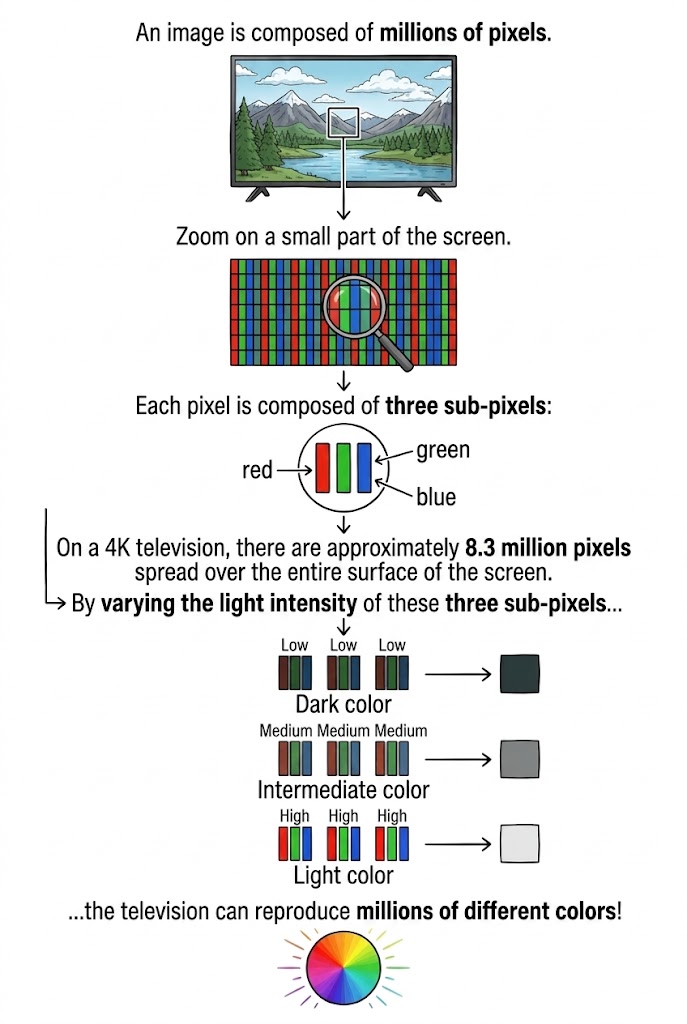
LCD: the basis of many modern technologies
But to display a visible image, these pixels must be illuminated.
It is precisely the way this light is produced that differentiates OLED, QLED, Mini-LED and MicroLED technologies.
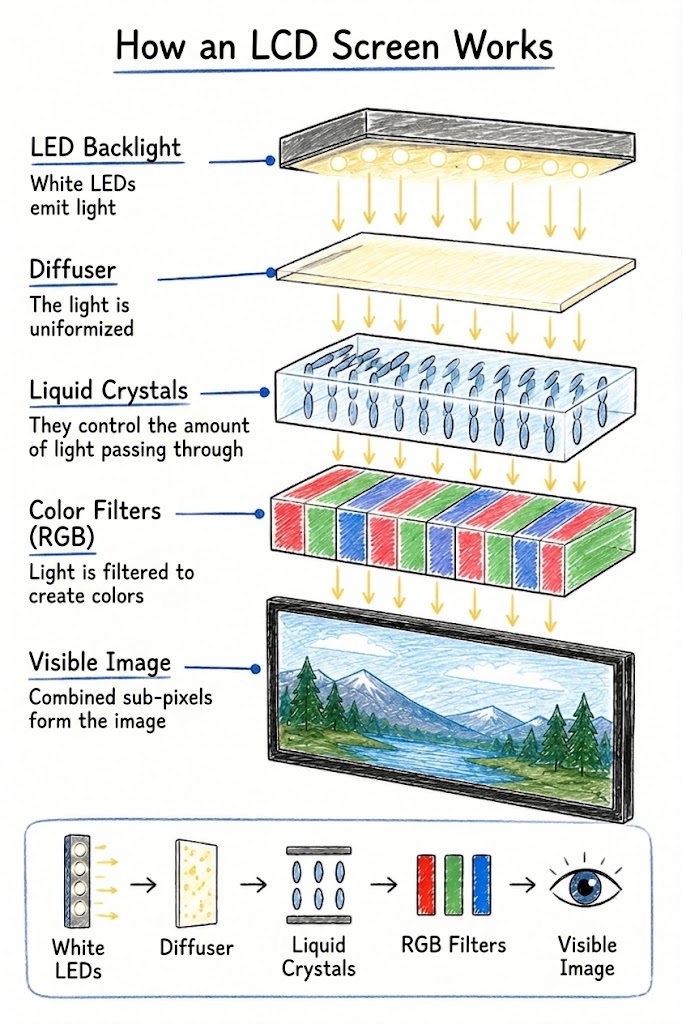
The majority of TVs sold today still rely on a technology called LCD (Liquid Crystal Display).
Contrary to what one might think, liquid crystals do not produce light.
They are only used to control the passage of light from a backlight system located behind the screen.
The operation can be summarized in three steps:
White LEDs on the back of the screen produce light.
This light passes through several optical filters.
Liquid crystals modulate the amount of light that reaches each pixel.
The main limitation of LCD
The backlight is always on.
Even when an area of the image should be black, the LEDs continue to emit light behind the screen.
The liquid crystals then try to block this light, but they can never stop it completely.
This is why the blacks on an LCD screen often appear dark gray rather than true black.
This limitation is at the origin of the development of newer technologies.
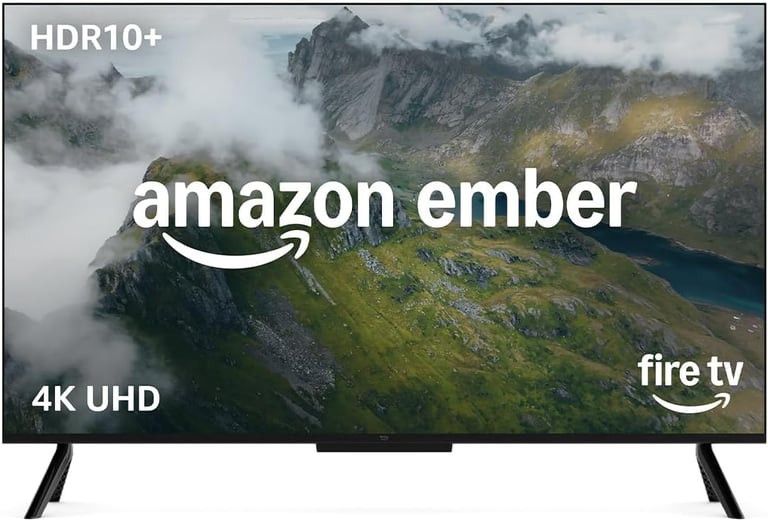
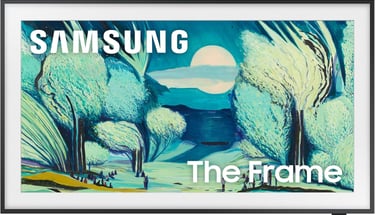
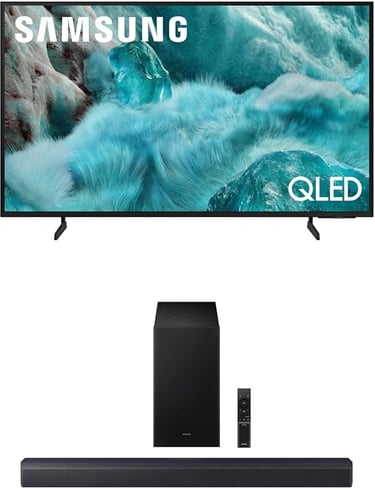
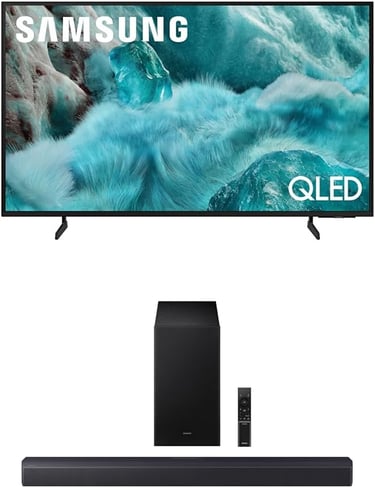
📺 The Most Popular TVs on Amazon in 2026
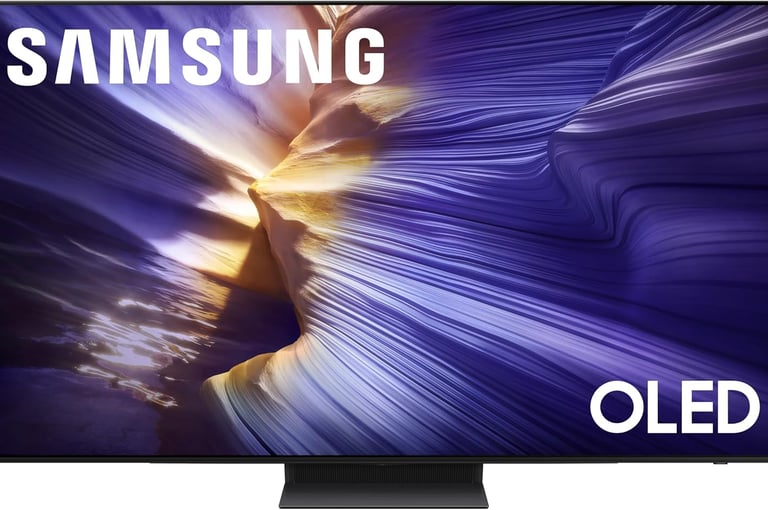
Are you thinking of replacing your TV for the Football World Cup? Here is a selection of popular models that stand out for their image quality, features, and value for money :
OLED: when every pixel becomes a light source
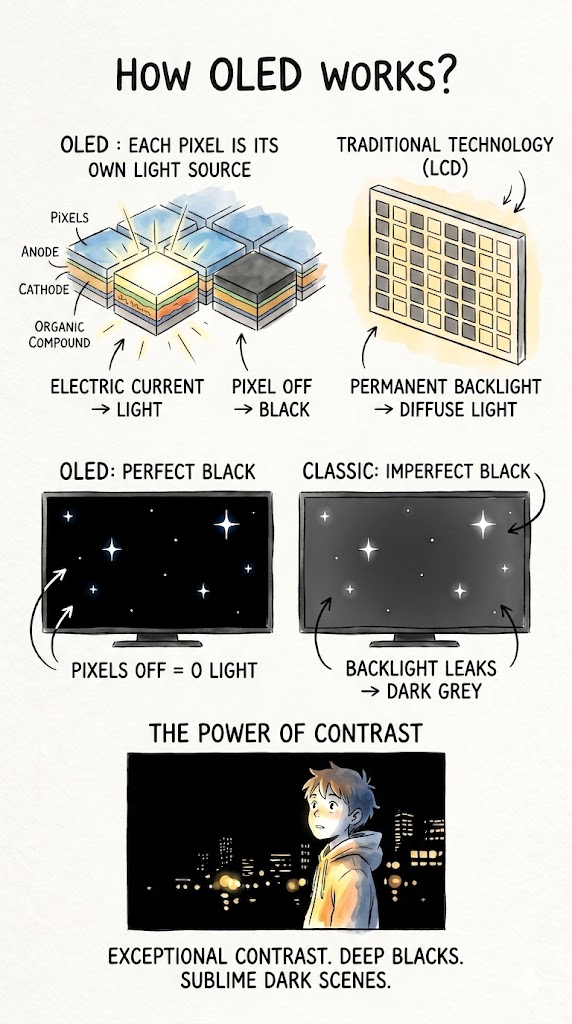
OLED (Organic Light Emitting Diode) technology takes a completely different approach.
Instead of using a backlight placed behind the panel, each pixel directly produces its own light.
Pixels contain electroluminescent organic materials capable of emitting light when an electric current passes through them.
This feature allows the backlight system to be completely removed.
Why does OLED offer exceptional contrast?
In an OLED display, each pixel can be controlled individually.
When an area of the image should be black, the pixels concerned are simply turned off.
They then produce absolutely no light.
The result is a perfect black.
This ability is especially noticeable in dark scenes in a movie or when displaying a starry sky.
The stars appear bright while the background remains completely black.
The advantages of OLED
The absence of a backlight brings several benefits:
Near-infinite contrast
Perfect Blacks
Excellent color accuracy
Very wide viewing angles
extremely low response time
OLED TVs are often considered the gold standard for home theater.
The limits of OLED
The maximum brightness is generally lower than that of the best Mini-LED TVs.
In addition, even if there are significant advances, organic materials naturally age over time.
This explains the theoretical risk of marking on certain intensive uses.
What are Quantum Dots?
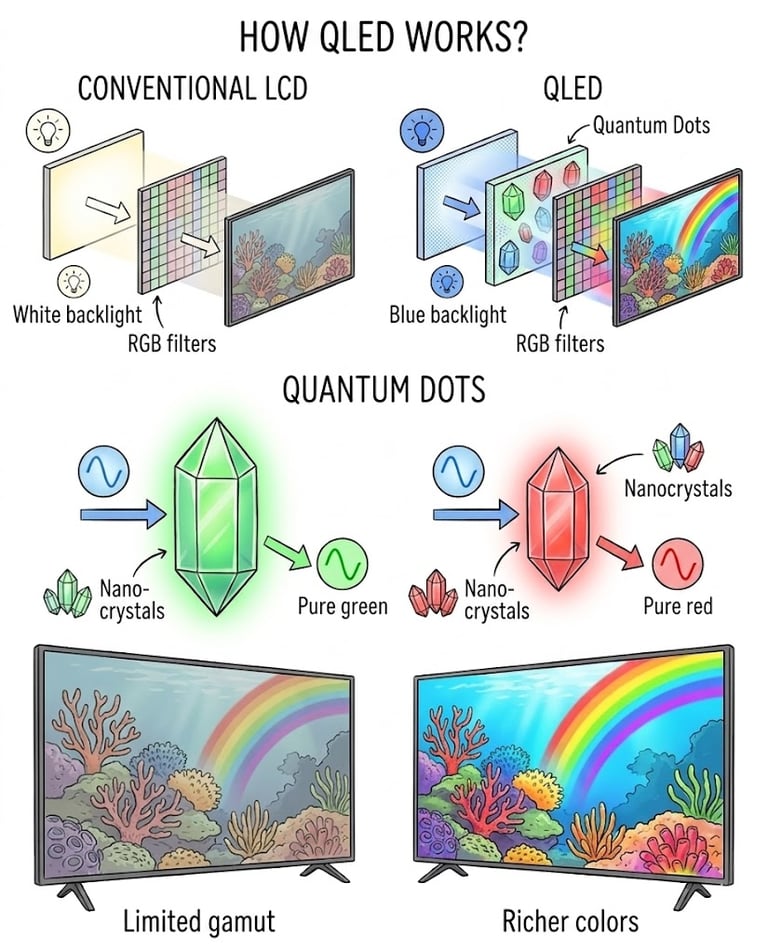
Quantum Dots are semiconductor nanocrystals capable of converting some of the blue light from the backlight into very pure red or green light.
The remaining blue light is used directly to produce the blue sub-pixel.
This technology allows for more accurate colors, better color space coverage, and high brightness.
QLED: the evolution of LCD thanks to Quantum Dots
QLED technology is still based on a classic LCD architecture.
However, an additional layer of nanoparticles called Quantum Dots is added between the backlight and the panel.
What's the point?
QLED TVs can:
Reproduce more shades of color
Achieve very high brightness
Maintain good image quality even in a very bright room.
Why doesn't QLED equal OLED?
Despite its performance, QLED retains the main flaw of LCD.
The light always comes from a backlight behind the screen.
It is therefore difficult to obtain perfectly black blacks in certain situations.
Mini-LED: Improving the backlight
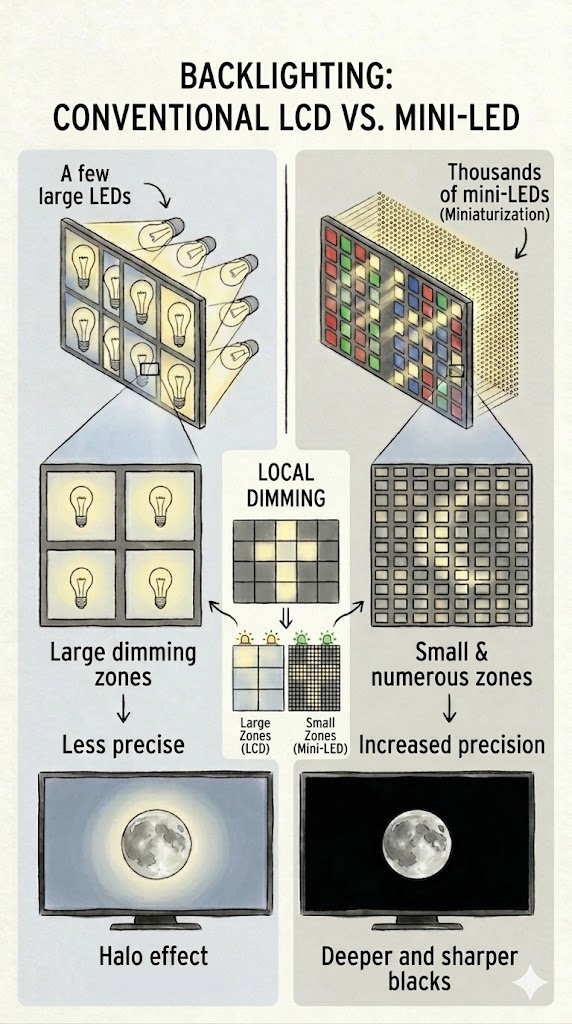
Mini-LED does not change the fundamental operation of the LCD.
The difference is in the size of the LEDs used for backlighting.
The LEDs are much smaller than on a conventional LCD TV.
This miniaturization makes it possible to integrate several thousand of them behind the panel.
Why is this important?
On a conventional LCD TV, the same LED can illuminate a relatively large area of the screen.
With Mini-LED, the backlight zones become much smaller and more numerous.
The TV can therefore control more precisely which parts of the image should be bright or dark.
This technique is called Local Dimming.
MicroLED: the technology of the future
MicroLED takes over the main advantage of OLED: each pixel produces its own light.
However, instead of using organic materials, this technology relies on microscopic inorganic LEDs.
Each pixel is therefore made up of a real miniature LED.
Conclusion
Behind the names OLED, QLED, Mini-LED and MicroLED are fundamentally different technologies.
OLED removes the backlight to allow each pixel to produce its own light. QLED improves LCD performance with Quantum Dots. Mini-LED perfects backlighting by using thousands of miniaturized LEDs. MicroLED, on the other hand, combines the advantages of these technologies in an even more advanced architecture.
Understanding how they work not only allows you to better choose your future television, but also to better appreciate the technological innovations behind the screens we use every day.

What are the advantages of MicroLED?
This architecture theoretically allows you to combine the best of both worlds:
Infinite contrast
Perfect Blacks
Exceptional brightness
Very long lifespan
On paper, MicroLED is currently the most powerful display technology.
Why is it not yet widespread?
The manufacture of a MicroLED TV is extremely complex.
For a 4K screen, you need to precisely position several tens of millions of microscopic LEDs.
This production difficulty explains the still very high prices of the models available.
Which technology to choose in 2026?
For movie and series lovers: OLED remains the benchmark thanks to its exceptional contrast and perfect blacks.
Whether it's sports, video games or brightly lit rooms: Mini-LED is often the best compromise between brightness, contrast and price.
QLED is a great alternative for those looking for a bright image at a more affordable price.
Finally, MicroLED probably embodies the future of televisions, even if its cost still reserves it for a very high-end market.
📺 The most popular TVs on Amazon in 2026:

🔎 Related articles :

Tech, simply.
Receive our new articles, tips and comparisons directly in your inbox.
©2026 The Tech BEHIND. All rights reserved
The Tech Behind participates in various affiliate programs. Some links on this site may generate a commission.