


The Impact of AI on Our Cognitive Abilities.
Does AI encourage intellectual laziness? An analysis of its impact on our cognitive performance and solutions for maintaining our critical thinking skills.
AI
Lucas GRANDIER
5/25/20265 min read


Imagine the scenario: you receive a 60-page technical report that you need to analyze by the next morning. A few years ago, this task would have required a large cup of coffee, a highlighter, and two hours of uninterrupted concentration. Today, all you have to do is upload the document to a generative AI tool. In less than five seconds, the summary is ready.
On paper, this is an undeniable boost to our productivity. A 2023 MIT study demonstrated that using these tools for writing at work reduced the time spent by 40% while improving perceived quality by 18%. However, on a neural level, a very different dynamic is taking shape. By delegating our thinking, our ability to synthesize information, and our memory to algorithms on a massive scale, we are entering an unprecedented intellectual comfort zone. Are we risking the atrophy of our analytical abilities in favor of immediacy ? And above all, how can we preserve our critical thinking in the face of the trap of convenience ?
Introduction
Neuroscience: The Essential Role of Mental Resilience
To understand what happens in our brains when we use artificial intelligence, we need to look at how we learn. Cognitive science teaches us a fundamental truth: memorizing and understanding a complex subject requires effort.
In the 1990s, American researcher Robert Bjork developed the concept of “desirable difficulties”. His work demonstrates that when our brain struggles to retrieve information or structure an idea, this resistance strengthens our neural connections. This is known as cognitive friction : the mental effort required to analyze and retain information. This mental exercise is the only guarantee of learning that is firmly anchored in long-term memory.
Artificial intelligence short-circuits this natural process. By providing us with ready-made answers, it robs us of the opportunity to figure things out for ourselves. This danger is all the greater because our attention is already being stretched to the limit by digital technology.
According to research by Dr. Gloria Mark (University of California), the average human attention span on a screen has dropped to just 47 seconds today, down from 2.5 minutes in 2004. By letting machines process information for us, we risk accelerating this loss of concentration. The machine reads, the machine summarizes, but in the end, our own memory has retained nothing.

The illusion of synthesis in the face of fragile attention
Reduced mental effort and decreased attention


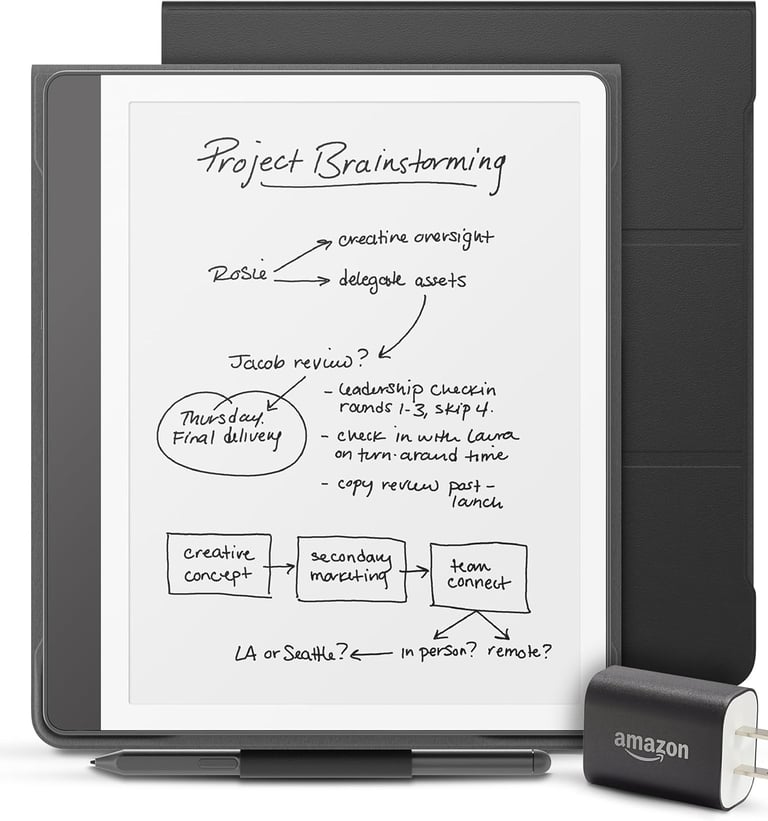
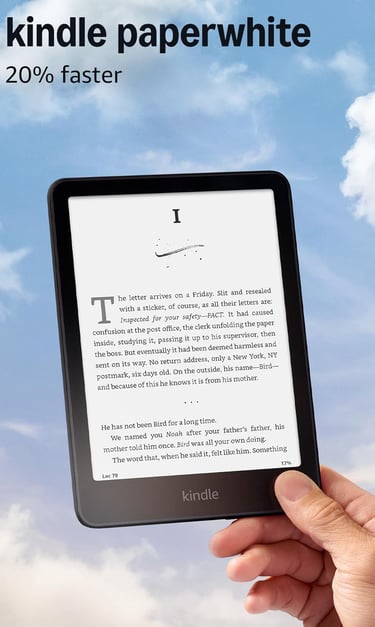
🔧 Essential tools for staying focused in the age of AI
Here is a selection of tools and books designed to improve concentration, reduce distractions, and promote deeper learning in a world dominated by digital technology:
When technology catches experts off guard
From Aviation to the Office: Two Psychological Pitfalls
The second major risk to our analytical abilities stems from our lack of perspective when dealing with automated tools. This phenomenon was first studied in aviation, where pilots who relied too heavily on autopilot found their manual reflexes deteriorating in emergency situations.
Today, this behavior is observed among knowledge professionals. Faced with the highly structured responses of an AI, our critical thinking goes to sleep, and we fall into two major psychological traps. The first is automation bias, our natural tendency to place blind trust in the results provided by a machine, to the point of lowering our guard. The second is the illusion of competence, which involves confusing the tool’s intelligence with our own abilities. The user then has the false impression of mastering a subject from start to finish, simply because the AI has produced a brilliant text for them.
The Harvard Study: Humans Demoted to the Role of Validators
Cognitive Hygiene: Methods for a Sharp Mind
This situation is not inevitable. Artificial intelligence remains an unprecedentedly powerful tool, provided we adopt genuine cognitive hygiene. This means establishing clear working rules to protect our mental capacities from complacency.

Protect the initial effort
The first rule is to protect the blank page stage. Before engaging in a discussion with an AI to solve a problem, force yourself to write down your initial ideas or the outline of your plan yourself. Even if imperfect, this solitary effort compels your brain to analyze the situation and structure its thoughts. The AI should only intervene afterward, to enrich, correct, or refine your ideas. The human must remain the driving force of the process, the machine its assistant.
Conclusion: Choose elevation over passivity
Ultimately, artificial intelligence is neither a miracle cure nor an inevitable threat to our intellectual capacities. It acts as a powerful amplifier of our existing habits. If we consistently choose the easy path, we do indeed risk atrophying and letting the algorithm do the thinking for us. But if we use it rigorously, while maintaining our own mental effort, it becomes an unprecedented tool for growth.
The true skill of tomorrow's worker will not be the ability to produce content faster than a computer. It will lie in their common sense, their resilience in the face of complexity, and their critical thinking skills to guide this technology. Faced with the lightning speed of machines, our greatest challenge is not to be even faster, but to continue thinking for ourselves.
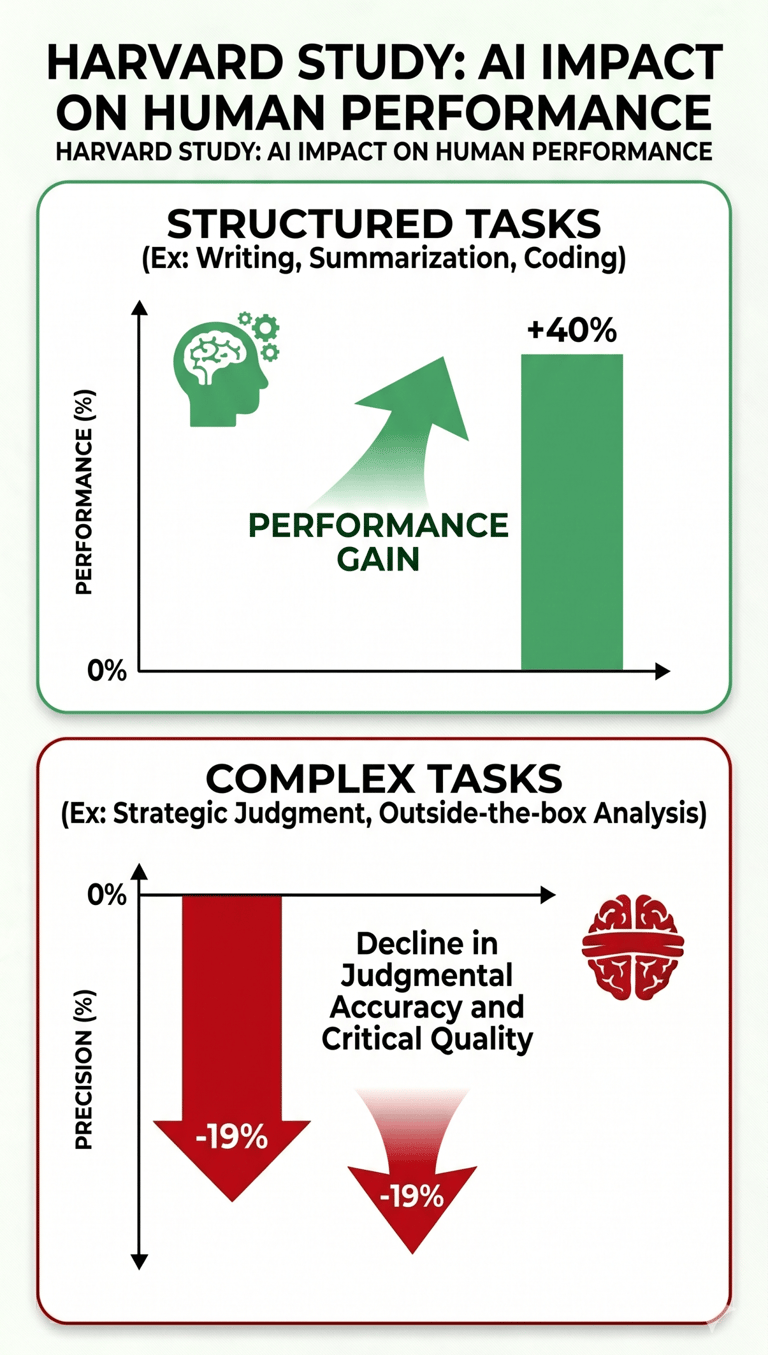
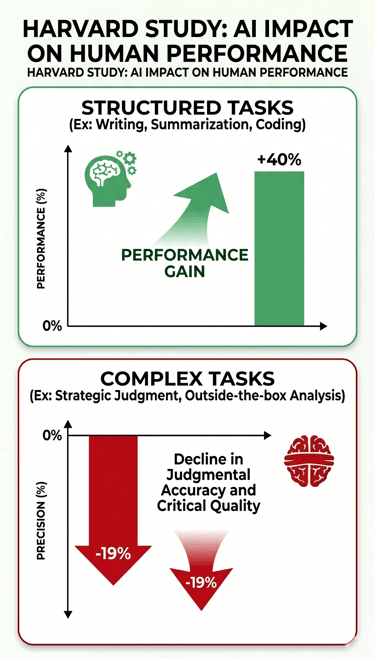
A major study conducted by Harvard University and BCG on 758 consultants perfectly illustrates this danger. Researchers found that for manageable creative tasks, professionals assisted by AI performed 40% better. However, when given a highly complex task, one that pushed the limits of what the machine could solve, the results were disastrous. Professionals using AI were 19% less likely to find the correct solution compared to those working independently.
Reassured by the machine's speed, they accepted its answer as absolute truth, neglecting to verify it or make the effort to challenge it. Without this verification process, the human becomes a mere passive validator.
Practicing Deep Work
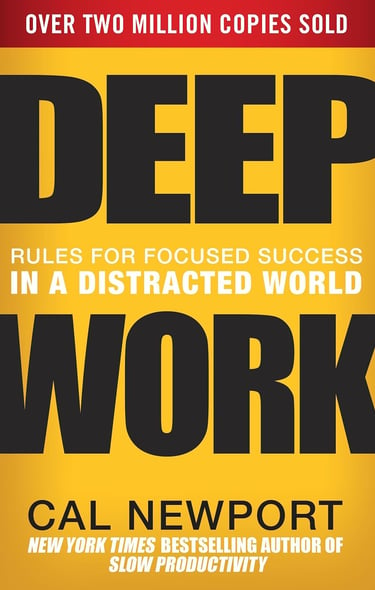
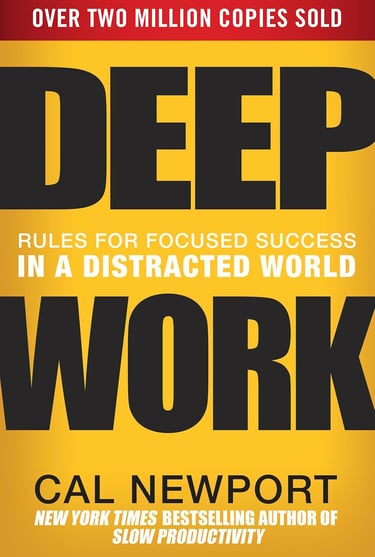
It is also vital to preserve our ability to work in deep work (an approach popularized by researcher Cal Newport). This refers to the ability to focus intensely, for extended periods, and without any distractions, on a demanding subject. In a world where a tool can generate thousands of words per minute, true human value will be found in nuanced thinking and discernment. Block out hours of completely disconnected work. Read entire documents without requesting automatic summaries, and force your brain to sustain its attention to build its endurance.
Transforming AI into a Debate Partner
Finally, rethink how you interact with these tools. Intellectual passivity sets in when we use AI as an oracle that holds all the answers. The solution is to make it a debate partner. Don't ask it to think for you : submit your deductions and ask it to find flaws, offer counter-arguments, or identify what you might have overlooked. By intentionally reintroducing contradiction and discussion into your research, you transform AI into a true training ground for your mind.
Essential tools for staying focused in the age of AI :


🔎 Related articles :

Tech, simply.
Receive our new articles, tips and comparisons directly in your inbox.
©2026 The Tech BEHIND. All rights reserved
The Tech Behind participates in various affiliate programs. Some links on this site may generate a commission.