


How does a satellite work?
A comprehensive guide to understanding how these complex machines stay in orbit and communicate with Earth.
Lucas GRANDIER
5/8/20267 min read


Right now, more than 8,000 active satellites are orbiting the Earth. They guide our cars, forecast the weather, broadcast TV shows, and connect remote villages to the Internet. Yet most of us don’t really know how it all works.
How can an object weighing several hundred pounds stay suspended in space without falling? How does it communicate with Earth? And what happens when it reaches the end of its life?
In this article, we demystify satellites from A to Z, without technical jargon or mathematical formulas. Just what you need to know to finally understand these silent guardians of our connected lives.
Part 1, Artificial Satellite: Definition and Role
Natural or artificial: what's the difference?
The word “satellite” comes from the Latin satelles, meaning “bodyguard.” In astronomy, a satellite is an object that orbits another. The Moon, for example, is Earth's natural satellite; it has been orbiting us for billions of years, without any human intervention.
An artificial satellite, on the other hand, is a man-made spacecraft launched into space aboard a rocket and designed to carry out a specific mission.
What are satellites used for?
There are several major families of satellites, each with a well-defined role:


A bit of history: it all began in 1957
On October 4, 1957, the Soviet Union launched Sputnik 1, a metal sphere weighing just 83 kg. It was the very first artificial satellite in history. It had only one mission: to transmit a radio signal. But that “beep beep” changed the world, sparking the space race between the United States and the USSR, and paving the way for the thousands of satellites that surround us today.
Part 2, Satellite Launch: From the Ground to Space in a Few Steps
The role of the rocket
To reach space, a satellite needs a rocket, a launch vehicle, that will propel it to a speed fast enough to escape Earth’s gravitational pull. Most satellites separate from the launch vehicle once the target altitude is reached, then deploy their solar panels and antennas autonomously.
The major players in the launch industry include Arianespace (Europe), SpaceX (United States), and Roscosmos (Russia), among others. In recent years, SpaceX has revolutionized the sector with its reusable Falcon 9 rockets, which return to land on Earth after launch, significantly reducing costs.

Different Orbits Explained Simply
Once launched, the satellite enters orbit : that is, a circular or elliptical path around the Earth. There are several types of orbits, depending on altitude and mission:


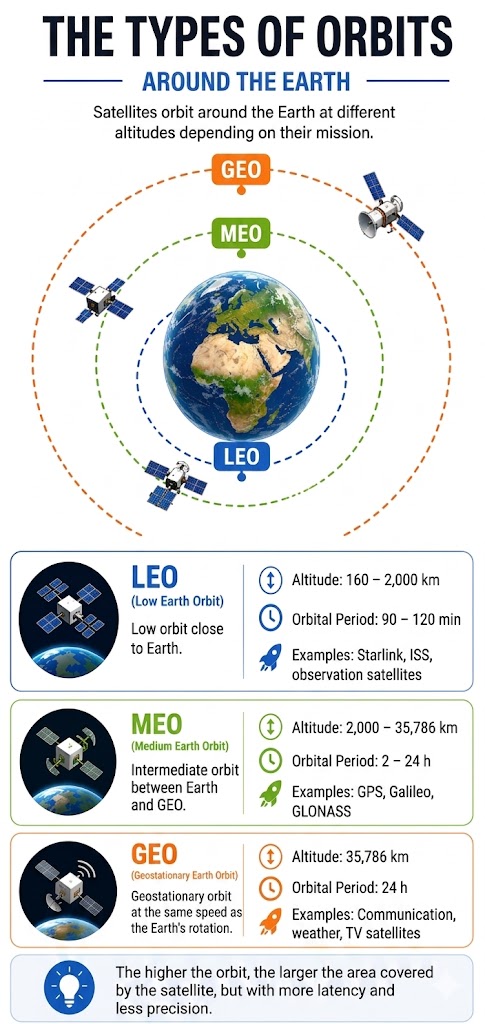
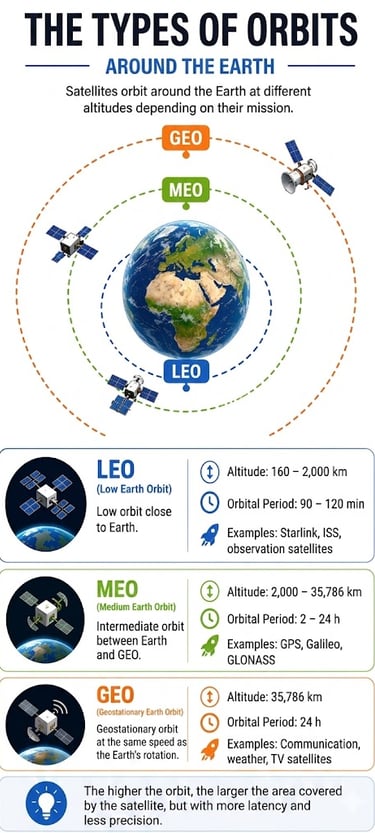


Geostationary orbit is particularly interesting : at an altitude of 36,000 km, a satellite orbits at exactly the same speed as the Earth. The result? It always remains above the same point. That is why a satellite dish always points in the same direction.
Why doesn't the satellite fall?
That’s THE question everyone asks. The answer can be summed up in a single image: imagine throwing a ball very hard horizontally from the top of a mountain. The harder you throw it, the farther it goes before hitting the ground. If you throw it fast enough, the ball’s trajectory follows the Earth’s curvature exactly; it “falls” continuously but never touches the ground.
This is exactly what happens with a satellite. It is in constant free fall, but its horizontal speed (about 28,000 km/h in low Earth orbit) exactly counteracts Earth’s gravitational pull. This is what is known as orbital equilibrium.
Part 3: The Components of a Satellite
A satellite is a bit like an autonomous robot in orbit. It has to generate its own power, communicate, and navigate on its own, thousands of miles away.
1. Solar panels: the satellite’s power source
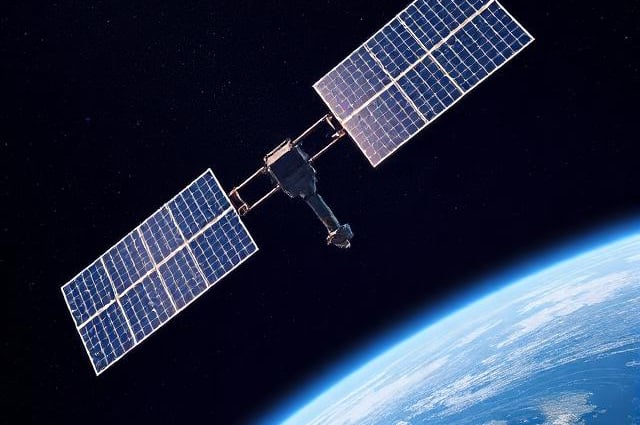
In space, there are no electrical outlets. Satellites generate power using their large solar panels, which they deploy as soon as they reach orbit. These panels convert sunlight into electricity, which powers all the systems on board.
During eclipses (when the satellite passes into the Earth’s shadow), rechargeable batteries take over. They store the energy accumulated in direct sunlight to power the satellite during periods of darkness.
2. Antennas: the link to Earth
Antennas are the satellite's “ears and mouth.” They enable it to receive instructions from ground stations and to send data, images, signals, and measurements back to Earth.
This connection is called the uplink (from Earth to the satellite) and the downlink (from the satellite to Earth). All of this is done via radio waves, which travel at the speed of light.
3. The onboard computer: the satellite's brain
Each satellite is equipped with an onboard computer that manages all systems in real time: orientation, power consumption, data transmission, and fault management.
It can receive updates or new instructions from Earth, but it is also capable of making certain decisions on its own if communication is interrupted.
4. Attitude control: staying on course
In space, nothing keeps the satellite in a fixed position. To ensure that its antennas point toward Earth and its solar panels toward the Sun, it must constantly adjust its orientation.
This is the role of the attitude control system, which uses gyroscopes, star trackers (which track the stars), and small thrusters to make micro-corrections. A true feat of engineering.


Part 4, Satellites and Everyday Life: Uses You Never Knew About
GPS: the most obvious example
When you open Google Maps or your car calculates a route, you’re using a constellation of satellites. The U.S. GPS system relies on 24 satellites in MEO orbit, which continuously transmit time-stamped signals. Your smartphone receives these signals, calculates the travel time for each one, and determines your location with an accuracy of a few meters.
Europe has its own system: Galileo, which is more accurate and independent of the U.S. GPS.






Weather: Seeing Earth from Space
Weather satellites continuously monitor clouds, surface temperatures, and winds on a global scale. This data is essential for the weather forecasts you check every day. Without satellites, forecasts beyond 48 hours would be far less reliable.
Satellite Internet: The Starlink Revolution
In recent years, companies like SpaceX (Starlink) and OneWeb have been deploying constellations of thousands of small satellites in low Earth orbit to provide high-speed internet access anywhere on Earth, including rural areas and the most remote regions. This represents a revolution for millions of people who lack access to fiber-optic or ADSL internet.
Earth observation: much more than just photos
Earth observation satellites are used to monitor deforestation, predict floods, guide farm tractors (precision agriculture), detect forest fires, and monitor borders. Programs like Copernicus (Europe) provide open data used by thousands of researchers and governments.
Part 5, End of a Satellite's Life: What Happens to Them?
How long does a satellite last?
The lifespan of a satellite varies depending on its type and orbit. Generally speaking, a telecommunications satellite in geostationary orbit has a lifespan of 10 to 15 years. Satellites in low Earth orbit have a shorter lifespan, typically 5 to 7 years.
The main limitation is the onboard fuel : the small thrusters used to adjust the orbit consume fuel. Once the fuel runs out, it becomes impossible to maintain the orbit or avoid a collision.
Space debris : a growing problem
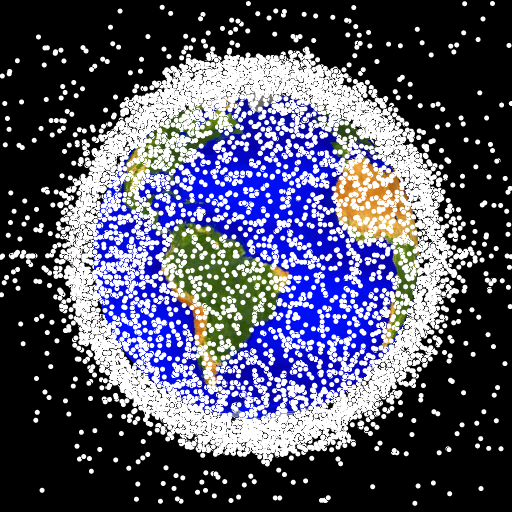
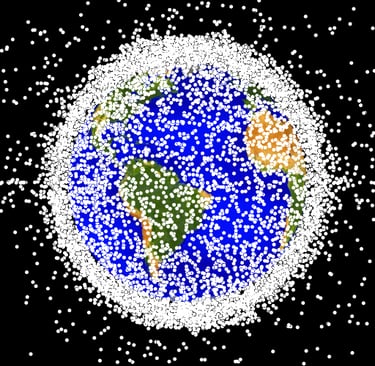
Over the course of 70 years of launches, thousands of defunct satellites, rocket debris, and fragments of all sizes have been orbiting the Earth. It is estimated that there are currently more than 27,000 pieces of debris being tracked by space agencies, and millions of fragments too small to be tracked.
This debris travels at 28,000 km/h. A single fragment just a few centimeters in size can be enough to destroy an operational satellite. This is known as the Kessler syndrome : a chain reaction of collisions that could render certain orbits unusable.
Solutions for a cleaner space
Space agencies and companies are actively working on this issue :
Controlled deorbiting : At the end of its operational life, a low-Earth orbit satellite is guided to re-enter the atmosphere and burn up.
Transfer to a graveyard orbit : Geostationary satellites are moved to a higher orbit, outside the operational zones.
Cleanup satellites : Experimental projects are testing nets, harpoons, and robotic arms to capture debris.
Conclusion: Satellites : The Silent Guardians of Our Connected World
In just a few decades, satellites have become as essential to our infrastructure as roads or power lines. They guide our journeys, connect our devices, monitor our planet, and help us forecast the weather. And all of this happens hundreds or thousands of kilometers above our heads, in silence.
The future looks even more ambitious: nanosatellites (CubeSats), no bigger than a shoebox, are making space more accessible to everyone. Mega-constellations like Starlink will connect the last remaining areas of the planet without internet coverage. And orbital cleanup missions are beginning to emerge to protect this increasingly precious environment.
Satellites are no longer the exclusive domain of space agencies and major nations. In their own way, they have become everyone's business.
📘 Further reading
Check out a selection of products related to the topic of this article:
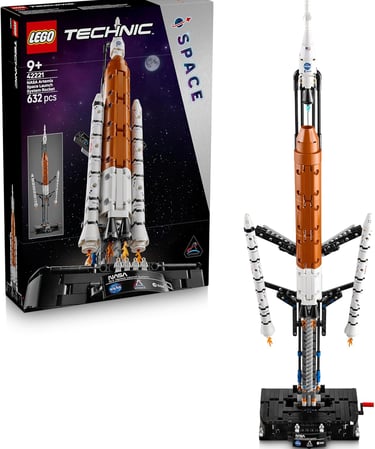
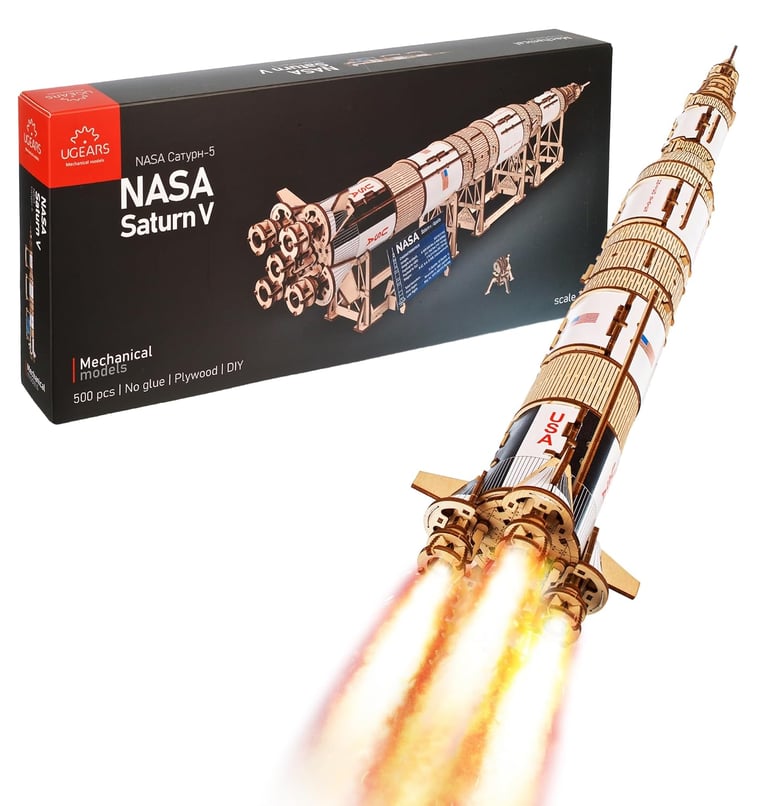
If you're also passionate about space, you might be interested in these products :
🔎 Related articles :

Tech, simply.
Receive our new articles, tips and comparisons directly in your inbox.
©2026 The Tech BEHIND. All rights reserved
The Tech Behind participates in various affiliate programs. Some links on this site may generate a commission.