


Electric or hybrid car: what are the differences and which one should you choose in 2026?
Electric or hybrid car: discover their differences, how they work, their advantages and disadvantages to choose the vehicle that best suits your needs.
ELECTRONICSEVERYDAY TECHNOLOGIES
Lucas GRANDIER
7/2/202611 min read


Electric and hybrid cars now account for a significant share of new vehicle sales. Faced with rising fuel prices, driving bans in some cities and advances in batteries, many motorists are wondering which engine to choose.
However, confusion persists. Many people think that a hybrid car is simply an electric car with a combustion engine. Others imagine that an electric car works exactly like a combustion car, but with a battery instead of a tank.
In reality, these two technologies are based on entirely different design philosophies.
In this article, we will first understand how an electric car works, then how a hybrid car works, before comparing their advantages, their limitations and determining which one best suits your use.
How does an electric car work?
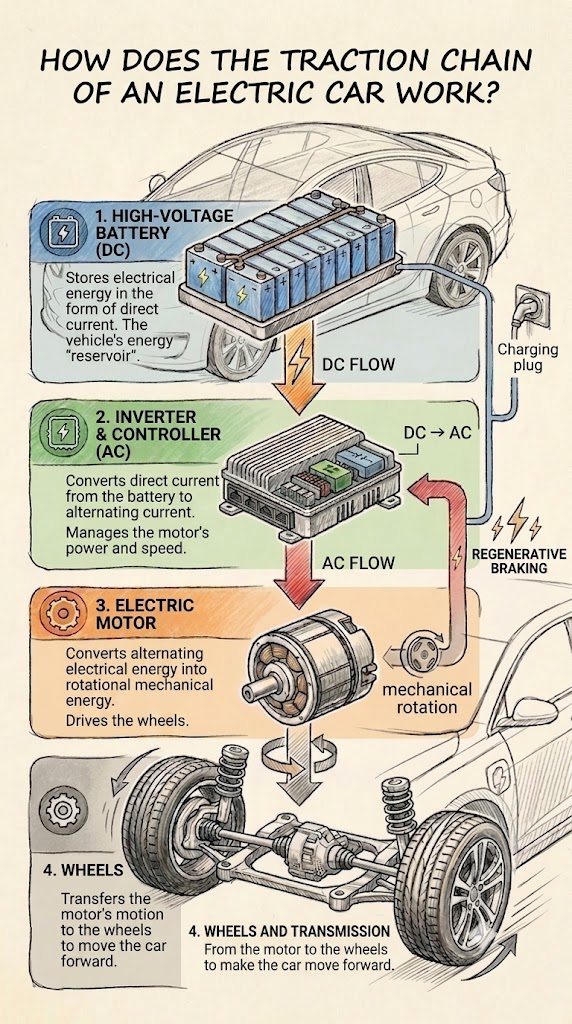
The battery: the energy reservoir
The battery is often compared to the tank of a combustion car. However, it is much more complex.
It is made up of several hundred, if not several thousand, lithium-ion cells, grouped into modules. These cells store electrical energy in chemical form before releasing it when the conductor accelerates.
Depending on the model, their capacity generally varies between 40 and more than 100 kWh, which directly influences the range of the vehicle.
But a battery doesn't just store energy. It is constantly monitored by an electronic system called the Battery Management System (BMS).
In particular, the BMS controls:
cell temperature
their blood pressure
their charge level
their balance
their safety
Without it, a battery could become prematurely damaged, lose performance or, in extreme cases, become dangerous.
💡Did you know ?
Lithium-ion batteries operate in an optimal temperature range. This is why many electric cars have a cooling or heating system to preserve their performance, especially when charging quickly.
The inverter: the conductor of power
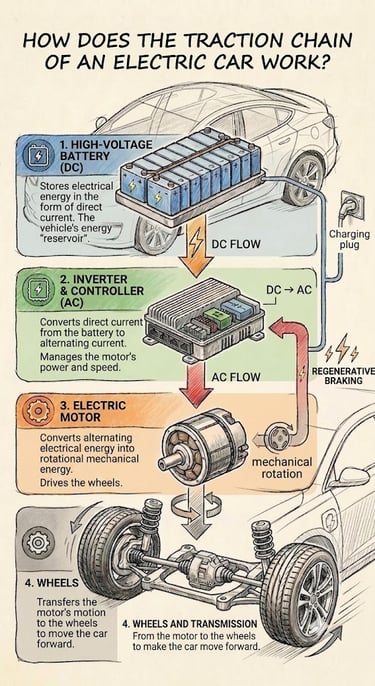
The battery provides direct current (DC).
However, most electric motors used in cars work with alternating current (AC).
This is where the inverter comes in, an often unknown but essential part.
Its role is to convert the direct current from the battery into alternating current, while precisely adjusting the frequency and voltage sent to the motor.
When you press the accelerator lightly, the inverter provides low power. If you use the full power of the vehicle, it instantly increases the energy transmitted to the engine.
This electronic management largely explains the responsiveness of electric cars.
The electric motor: impressive efficiency
The electric motor directly converts electrical energy into mechanical energy.
Unlike a combustion engine, it does not need to burn fuel to produce movement.
This difference explains its very high efficiency.
While a combustion engine typically converts 20-40% of the energy from the fuel into motion, an electric motor can exceed 85%, with some estimates even reaching more than 90% under optimal conditions.
As a result, less energy is lost in the form of heat.
Another major advantage: the maximum torque is available from the first revolutions of the wheel.
That's why an electric car often offers very sharp acceleration, even with moderate power.
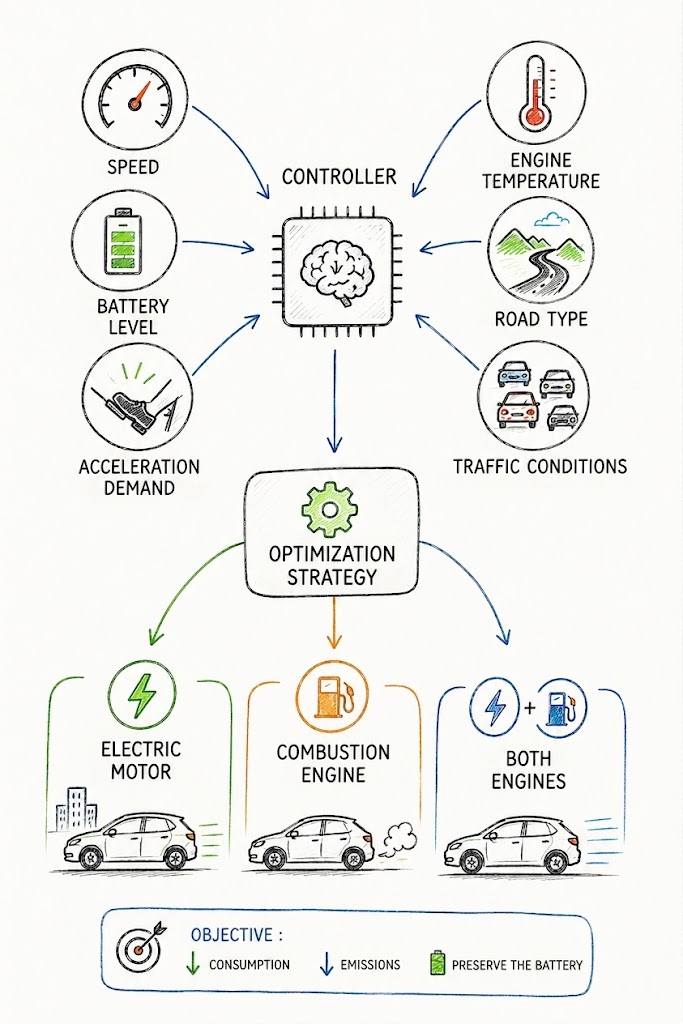
How does the car decide which engine to use?
This is one of the most interesting aspects of hybrids.
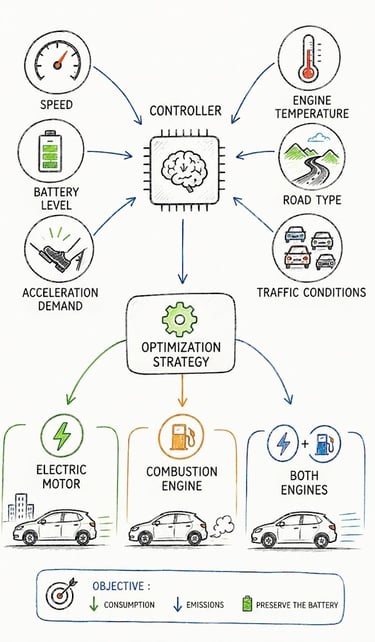
The calculator continuously analyzes several parameters:
Vehicle speed
Battery charge level
Acceleration request
Engine temperature
Type of road (city, highway, uphill)
Traffic status
Then, it applies an optimization strategy.
Regenerative braking: recovering energy that would otherwise be lost
On a combustion car, each braking dissipates kinetic energy in the form of heat at the level of the brakes.
An electric car takes a different approach.
When the driver releases the accelerator or brakes, the electric motor temporarily changes its role.
Instead of consuming electricity, it becomes a generator.
The energy produced is then returned to the battery for later use.
This process, called regenerative braking, improves range, especially in the city where deceleration phases are frequent.
How does a hybrid car actually work?
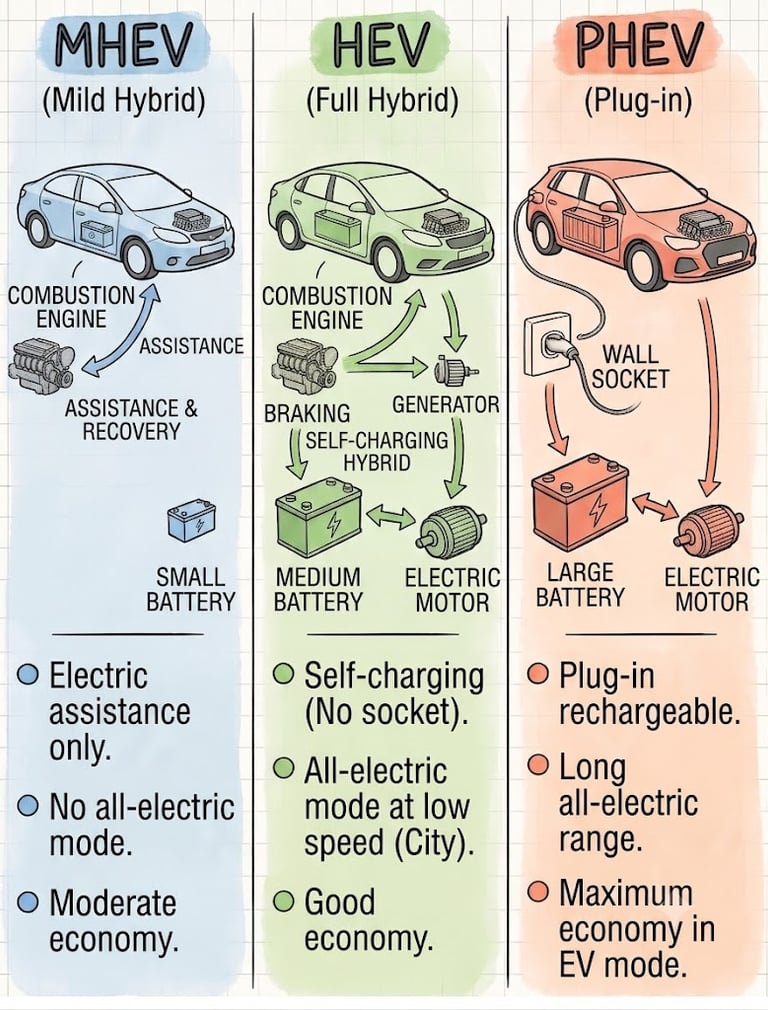
Unlike an electric car, a hybrid car is not based on a single powertrain, but on two energy systems that must work together at all times:
a combustion engine (petrol or diesel)
an electric motor powered by a battery
The main challenge is not only to keep the car running, but to choose the most efficient energy source in real time.
This decision is entirely managed by one or more ECUs called Hybrid Control Units (HCUs).
The different hybrid architectures
1. Mild Hybrid (MHEV)
This is the simplest form.
The electric motor cannot drive the wheels alone. It only serves as an assistance to the combustion engine.
Main roles:
Quick start of the combustion engine
Acceleration Assist
Braking energy recovery
Reduced consumption
👉 The combustion engine is still the main source of propulsion.
2. Classic Hybrid (HEV)
This is the type popularized by models like the Toyota Prius.
Here, the electric motor can move the car forward on its own over short distances (especially in the city).
How it works:
Often electric starting
Low-speed electric driving
Combustion engine activated if needed
Braking energy recovery
3. Plug-in hybrid (PHEV)
This is the most advanced version.
It has a much larger battery, which can be recharged from an electrical outlet.
Special features:
Electric range from 20 to 100 km depending on the model
External charging possible
Automatic switching between electric and combustion
👉 It is an electric car on short journeys and a combustion engine car on long journeys.
Technical comparison: electric vs hybrid
1. Energy efficiency
Fuel efficiency is the proportion of energy that is actually transformed into useful movement to move the vehicle forward. In an electric car, this efficiency is particularly high, as the electric motor converts around 85 to 90 percent of the battery's energy into mechanical energy. Very little energy is lost in the form of heat or friction, which is due to a simple architecture and a small number of moving parts.
Conversely, a hybrid car is still based on a combustion engine, whose efficiency is intrinsically lower because of losses related to combustion, heat and mechanical friction. Even though the electric motor and regenerative braking improve the overall efficiency of the system, the efficiency of a hybrid vehicle generally remains around 50 to 60% depending on the driving conditions and the type of hybridization.
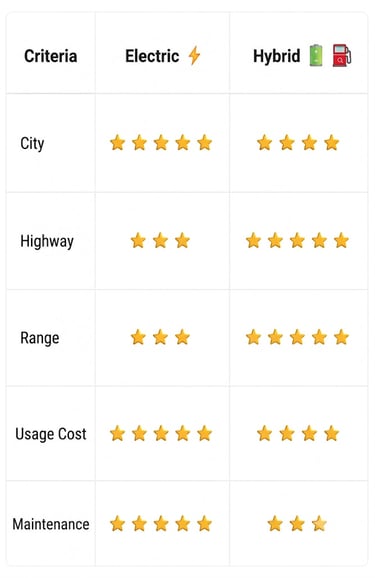
👉 Conclusion: from a purely energy point of view, the electric car is currently the most efficient solution, because it maximizes the conversion of stored energy into useful motion while greatly limiting losses.
2. Consumption and cost of use
The electric car generally has a net advantage in terms of consumption and cost of use. Electricity is on average cheaper than fuel per kilometre travelled, which significantly reduces the overall cost of travel. In addition, the electric motor is highly energy efficient, which limits losses and optimises every kWh consumed. Maintenance is also reduced, which helps to lower the total cost over the life of the vehicle.
The hybrid car, on the other hand, reduces consumption compared to a conventional combustion vehicle, thanks to the assistance of the electric motor and energy recovery during braking phases. However, its performance in terms of consumption is highly dependent on the driving style and the type of journey. In the city, it is particularly efficient, while on the highway or in sustained driving, the advantage is more limited.
👉 In short, electric offers a lower and more stable cost per kilometre, while hybrid is above all an intermediate solution optimised for reducing consumption without recharging.
3. Maintenance
The electric car is distinguished by a much simpler mechanics than that of combustion or hybrid vehicles. It doesn't have a clutch or complex gearbox, and its engine has far fewer moving parts. This mechanical simplification naturally reduces the sources of wear and breakdown. In addition, regenerative braking limits the use of traditional brakes, which slows down the wear of pads and discs.
Conversely, a hybrid car combines two propulsion systems, which increases the overall complexity of the vehicle. It requires both the classic maintenance of a combustion engine (oil changes, filters, belts, etc.) and that of the electrical components, even if the latter generally require less maintenance. This dual architecture therefore leads to more frequent and more diversified maintenance.
👉 Conclusion: thanks to its mechanical simplicity, the electric car generally has a lower maintenance cost than a hybrid car.
4. Battery life and actual use
The electric car offers a range directly linked to the capacity of its battery. This makes it more dependent on charging, which requires some planning, especially for longer journeys. Access to a network of charging stations or the possibility of charging at home then becomes a determining factor in daily use.
The hybrid car, on the other hand, retains a conventional fuel tank in addition to its battery. This allows it to benefit from an almost unlimited range, comparable to that of a combustion vehicle. It is therefore much less dependent on charging infrastructure, which makes it more flexible for long journeys or unpredictable uses.
👉 In short, electric vehicles require organisation around charging, while hybrids offer freedom of use closer to traditional combustion vehicles.
5. Environmental impact
Life cycle assessments show that the electric car generally generates more CO₂ emissions during its manufacture, mainly because of the production of the battery, which is energy-intensive. On the other hand, this initial "additional carbon cost" is gradually compensated for during use, thanks to its excellent fuel efficiency and the absence of direct tailpipe emissions.
According to the Agency for Ecological Transition and several life cycle studies, an electric car often becomes more advantageous than a combustion or hybrid vehicle after several tens of thousands of kilometres travelled, depending on the country's energy mix. Conversely, a hybrid car reduces emissions compared to a conventional combustion vehicle, but it remains dependent on fuel combustion throughout its use.
👉 In conclusion, the environmental impact depends strongly on the use profile of the vehicle as well as the origin of the electricity used, particularly in the context of the national energy mix.
Which car to choose according to your profile?
1. You mainly ride in the city
🏆 Best choice: electric car
Why?
Short and repetitive journeys
frequent braking (therefore optimal energy recovery)
Highly efficient electric motor at low speeds
Comfort (silence, absence of vibrations)
Result:
It is in this context that the electric car is at its maximum energy and economic performance.
2. You do a lot of highway riding
🏆 Best choice: hybrid or plug-in hybrid
Why?
Electric consumes more at high speeds
The hybrid can switch to the combustion engine, which is more suitable
Immediate autonomy without recharging constraints
Ideal case:
plug-in hybrids if recharging possible regularly
Conventional hybrids if mixed use without infrastructure
3. You can charge at home
🏆 Best choice: electric car
This is one of the most decisive criteria.
Why?
Slow charging at night = always full battery
Lower cost of electricity than fuel
Easier everyday use
4. You can't charge easily
🏆 Best Choice: Hybrid
Why?
No dependence on terminals
Automatic operation
Reduced consumption without changing habits
5. You make mixed trips (city + long trips)
🏆 Best choice: plug-in hybrid (PHEV)
Why?
Electric in the city
Thermal on the highway
Maximum flexibility
⚠️ Be careful: if it is not charged regularly, a PHEV often becomes less efficient than a conventional hybrid.
🔌 Gear up to charge your vehicle
If you are considering the purchase of an electric car or a plug-in hybrid, discover our top 3 best electric charging stations in 2026:
Comparison Summary: Electric vs Hybrid

Conclusion: should you choose electric or hybrid?
The choice does not depend only on the technology, but on the equation of use + infrastructure + budget.
👉 The electric car is ideal if:
You mostly ride in the city
You can charge easily
You are looking for a minimal cost of use
You prefer mechanical simplicity
👉 The hybrid car is ideal if:
you make long regular journeys
You don't have access to a simple top-up
You want to keep the flexibility of the fuel
You are looking for a gradual transition to electric
💡 Our top 3 best charging stations in 2026:
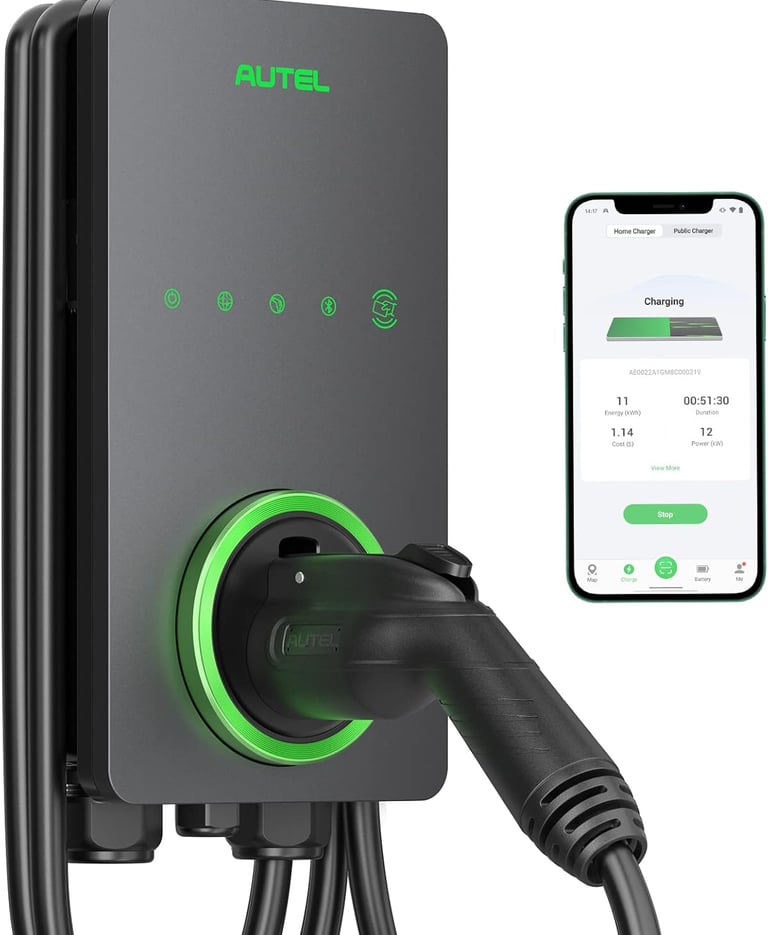
🥇 1. Autel MaxiCharger Level 2 (Up to 50 A) – Best Value for Money
Estimated price: $450–$650
Why we recommend it :
The Autel MaxiCharger Level 2 is one of the best home EV chargers in its price range, combining excellent performance, smart features, and reliable build quality. Designed for both indoor and outdoor installation, it delivers up to 50 amps of charging power at 240 V, significantly reducing charging times compared to a standard household outlet.
With built-in Wi-Fi and Bluetooth connectivity, the Autel Charge mobile app allows you to schedule charging sessions, monitor energy consumption, and manage your charger remotely. Its 25-foot (7.6 m) cable provides plenty of flexibility, making it easy to reach your vehicle regardless of your garage or driveway layout.
Highlights :
✅ Up to 50 A charging power (240 V)
✅ Fast Level 2 charging
✅ Built-in Wi-Fi and Bluetooth
✅ User-friendly Autel Charge mobile app
✅ 25-foot (7.6 m) charging cable
✅ Suitable for indoor and outdoor installation
✅ Durable, weather-resistant construction
Drawbacks :
❌ Uses a J1772 connector (Tesla vehicles require an adapter unless equipped with a J1772 adapter)
❌ Advanced solar energy integration is more limited than on some premium EV chargers
👉 Best for: Homeowners looking for a powerful, connected, and reliable EV charger that offers excellent value for money.
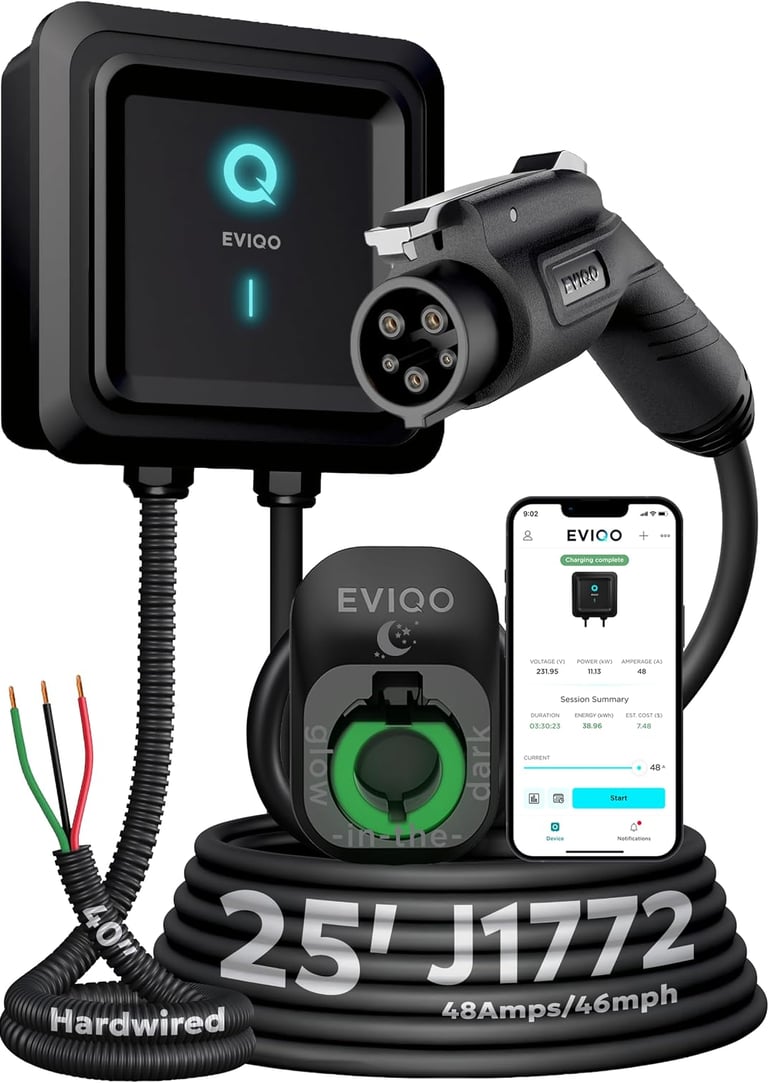
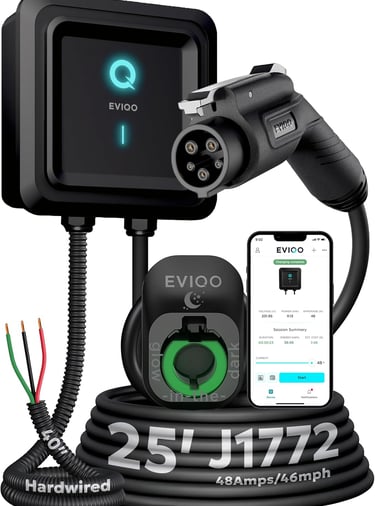
🥈 2. EVIQO Level 2 EV Charger (48 A) – Best Smart Home Charger
Estimated Price: $400–$550
Why We Recommend It :
The EVIQO Level 2 EV Charger is an excellent choice for homeowners looking for a powerful, feature-rich charging station at a competitive price. Delivering up to 48 amps (11.5 kW) at 240 V, it provides fast and reliable charging for most non-Tesla electric vehicles equipped with a J1772 connector.
Its built-in 2.4 GHz Wi-Fi connectivity and intuitive smart app allow users to schedule charging sessions, monitor energy consumption, and remotely manage the charger from anywhere. Designed for long-term reliability, it features an IP66 weatherproof enclosure, a 25-foot charging cable, and is both UL and ETL certified, making it suitable for indoor and outdoor installation.
Highlights :
✅ Up to 48 A (11.5 kW) charging power
✅ Fast Level 2 charging
✅ Built-in 2.4 GHz Wi-Fi
✅ Smart mobile app with scheduling and energy monitoring
✅ 25-foot (7.6 m) charging cable
✅ IP66 weatherproof (indoor & outdoor use)
✅ UL & ETL certified
✅ Hardwired installation for maximum performance
Drawbacks :
❌ Hardwired installation requires a qualified electrician
❌ J1772 connector (Tesla vehicles require an adapter)
👉 Best for: Homeowners looking for a smart, durable, and weather-resistant EV charger with premium features at an excellent price.
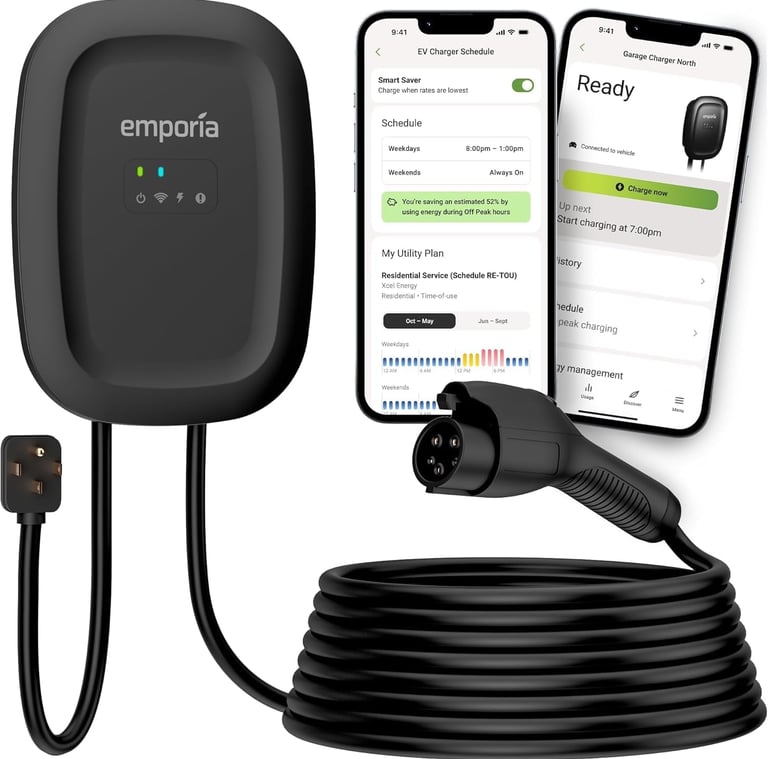
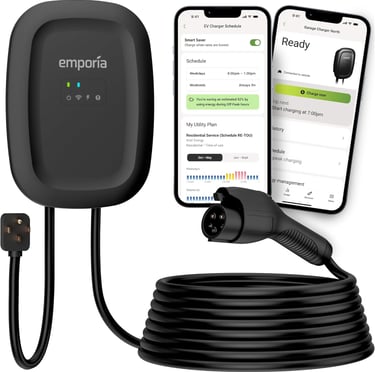
🥉 3. EMPORIA Level 2 EV Charger (48 A) – Best Budget Pick
Estimated Price: $350–$450
Why We Recommend It :
The EMPORIA Level 2 EV Charger is one of the best value-for-money home charging stations available on Amazon. Delivering up to 48 amps (11.5 kW) at 240 V, it provides fast and reliable charging for most electric vehicles equipped with a J1772 connector. Its NEMA 14-50 plug makes installation straightforward for homeowners who already have a compatible outlet, while hardwired installation is also supported for maximum performance.
What sets the Emporia charger apart is its excellent smart energy management. Through the Emporia Energy app, users can schedule charging sessions, monitor electricity consumption in real time, and optimize charging during off-peak hours. Combined with its 25-foot charging cable and robust build quality, it offers premium features at a highly competitive price.
Highlights :
✅ Up to 48 A (11.5 kW) charging power
✅ Fast Level 2 charging
✅ Wi-Fi enabled with the Emporia Energy app
✅ Real-time energy monitoring
✅ Smart charging schedules
✅ 25-foot (7.6 m) charging cable
✅ NEMA 14-50 plug for easy installation
✅ Excellent value for money
Drawbacks :
❌ J1772 connector (Tesla vehicles require an adapter)
❌ Fewer advanced features than some premium EV chargers
👉 Best for: Homeowners looking for an affordable, reliable, and smart EV charger that delivers excellent performance without breaking the bank.
🔎 Related articles :

Tech, simply.
Receive our new articles, tips and comparisons directly in your inbox.
©2026 The Tech BEHIND. All rights reserved
The Tech Behind participates in various affiliate programs. Some links on this site may generate a commission.