


The architecture of Bitcoin: Why hacking the network defies the laws of physics
No servers or firewalls. Discover the technical architecture of Bitcoin and why hacking it defies the laws of thermodynamics.
FINTECHCYBERSECURITY
Lucas GRANDIER
6/24/20266 min read


Since its creation in 2009 by the mysterious Satoshi Nakamoto, Bitcoin has survived thousands of attempted attacks, major financial crises, and billions of dollars in economic stakes.
However, one question keeps coming up: why has no one managed to hack Bitcoin?
After all, banks are attacked, businesses suffer cyberattacks, and even governments sometimes have their systems compromised. So why does Bitcoin seem to hold up?
The answer doesn't lie in magical software or a well-kept secret. It lies in a unique computer, mathematical, and energy architecture that makes any attack extraordinarily costly, if not physically impossible.
In this article, we will discover how blockchain, cryptography, and hardware consensus are transforming Bitcoin into one of the most resilient systems ever designed.
1. What exactly is blockchain?
2. Immutability: why modifying a block is impossible
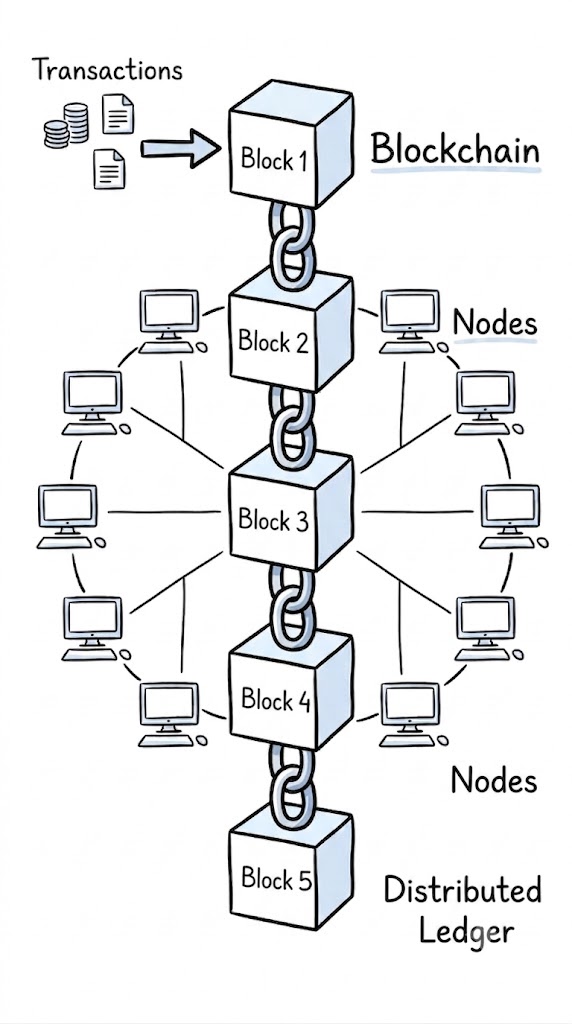
Bitcoin is often described as a digital currency. In reality, Bitcoin is primarily a vast, shared, and distributed ledger.
This ledger contains the complete history of all transactions made since 2009. Instead of being stored on a vulnerable central server belonging to a bank, this ledger is copied onto tens of thousands of computers distributed around the world. These computers are called nodes.
Transactions are grouped into sets called blocks.
Each new block contains:
new transactions
a cryptographic reference to the previous block
various technical information necessary for network validation
The blocks are thus linked together, forming a chain: the blockchain.
If a node disappears or is compromised, the rest of the network continues to function normally thanks to the thousands of other available copies. This redundancy constitutes Bitcoin's first line of absolute defense.
Bitcoin's true strength lies in what is called its immutability.
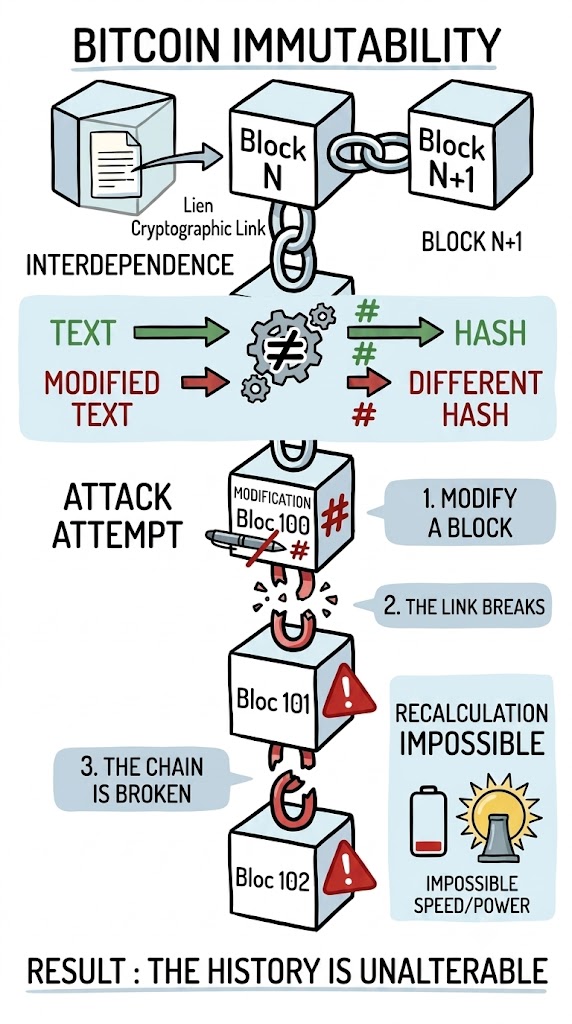
Each block has a unique digital fingerprint called a hash. This fingerprint is calculated from the exact entire contents of the block. The slightest change completely alters the resulting hash.
For example :
"Bitcoin" → A1B2C3...
"bitcoin" → F9D7E2...
A simple difference in capitalization produces a completely different result. However, each block also contains the hash of the previous block.
Thus, if a hacker attempts to modify a transaction dating back several years:
The hash of the block in question changes radically
The following block, which pointed to the old hash, becomes invalid
Due to a domino effect, all subsequent blocks also become invalid
This would require recalculating the entire blockchain faster than the rest of the global network. It is this cryptographic dependency between blocks that makes the data virtually impossible to falsify.
3. SHA-256 cryptography and thermodynamic limits
At the heart of Bitcoin is a cryptographic hash function called SHA-256. This function transforms any data into a 256-bit digital fingerprint.
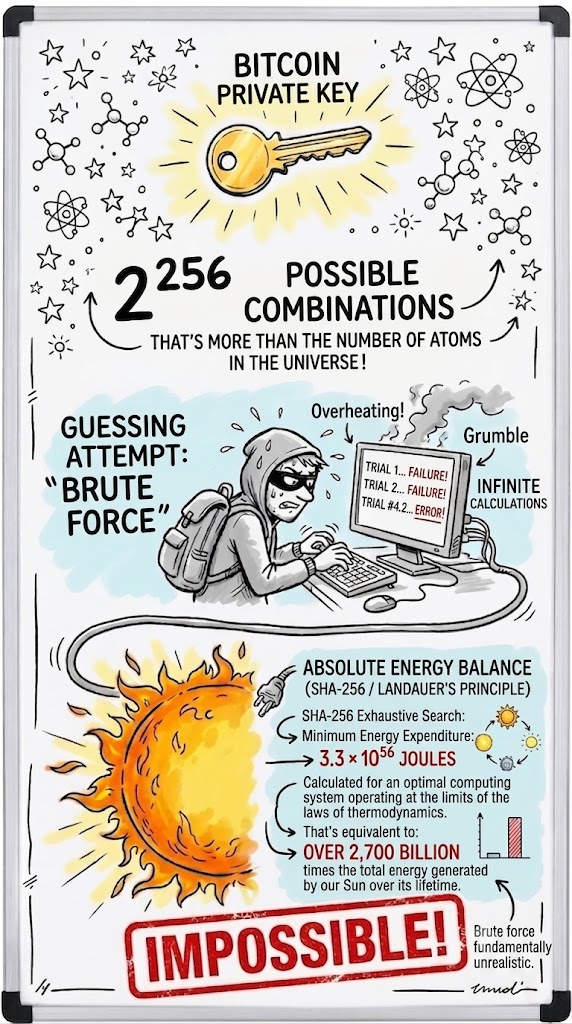
The number of possible combinations for a private key (your password for spending your funds) is 2^256. This is a number comparable to the number of atoms in the observable universe. But security doesn't stop at mathematics: it also touches on fundamental physics.
According to Landauer's principle , exhaustively searching for all possible input data for an SHA-256 hash would require a minimum energy expenditure of 3.3 x 10^56 joules, even using an optimal computer system operating at the limits of thermodynamic laws. Given that this value is equivalent to more than 2.7 trillion times the total energy generated by the Sun during its lifetime, a brute-force attack is now recognized as fundamentally impossible according to the laws of the universe.
That's why directly hacking the network keys defies the laws of physics.
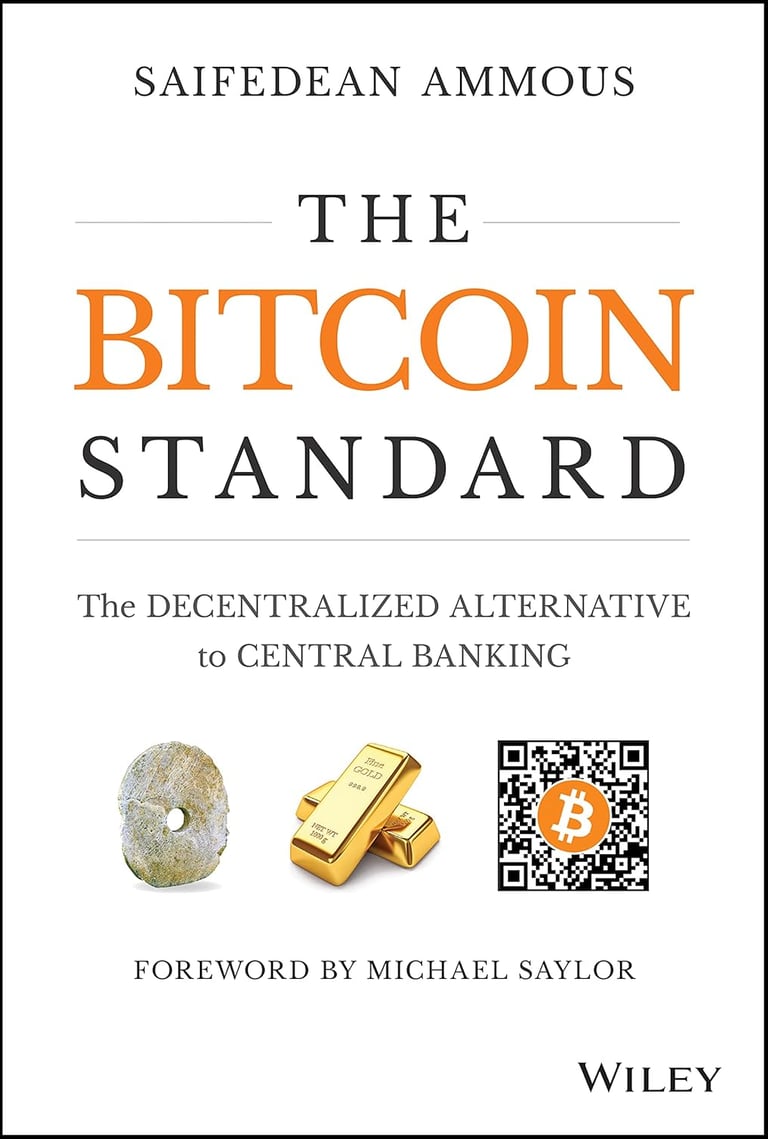
The Bitcoin Standard – Saifedean Ammous
This book contains not a single line of code, yet it is essential for understanding the architecture of Bitcoin. Saifedean Ammous analyzes the history of money through the lens of engineering and scarcity. He explains why gold was chosen as the "monetary technology" for centuries and how modern fiat currencies (like the euro or the dollar) have systemic flaws.
Why read it? To understand the "why" before the "how". The book demonstrates how the Bitcoin network, with its strict cap of 21 million units and adjustable mining difficulty, was conceived as a perfect embedded system to solve the age-old problem of inflation and centralization.
Conclusion: A fortress built on mathematics and physics
Bitcoin's security does not rely on a secret password or a corporate firewall. It rests on three fundamental pillars: an immutable blockchain, cryptography bordering on the laws of thermodynamics, and highly specialized computer hardware (ASICs) guaranteeing decentralized consensus.
To falsify the blockchain, an attacker would have to simultaneously overcome mathematics, hardware logistics, and elementary physics. It is precisely this symbiosis that makes Bitcoin one of the most secure embedded systems ever created on a global scale.
Recommended books for further reading
4. Decentralized Consensus and Hardware Strength (ASIC)
A traditional bank decides on its own which transactions are valid. Bitcoin, however, relies on a mechanism called Proof of Work .
Actors called miners use considerable computing power to solve cryptographic problems. But be aware, they don't use simple laptops. Mining relies on ASICs (Application-Specific Integrated Circuits), silicon chips developed with the sole function of calculating the SHA-256 algorithm at lightning speed.
This ongoing competition creates a global consensus. To cheat, an attacker would have to produce more computing power than all the other miners combined.
Today, this would require seizing control of global semiconductor supply chains and diverting electricity production from several countries to power this equipment. The logistical and energy costs of such an operation amount to tens of billions of euros. Attacking Bitcoin is therefore, by definition, an economic aberration.
Contrary to popular belief, Bitcoin has already been the target of numerous attacks. However, successful attacks almost always target users or external platforms , and not the protocol itself.
Private key theft (Phishing): This is the most frequent scenario. Social engineering targets humans. This is why many users protect their funds with hardware wallets , devices containing secure microcontrollers that physically isolate the private key from the internet.
The 51% attack: A theoretical attack that would control more than 50% of the world's computing power. As previously mentioned, the hardware investment would be enormous, and the attack would cause the network's value to plummet, rendering the hack pointless.
The quantum threat: Quantum computers are often presented as a threat. In reality, no existing quantum machine is capable of breaking these mechanisms. Moreover, Bitcoin's architecture is designed to evolve through software consensus: "post-quantum" cryptography could be implemented long before the danger becomes a real threat.
5. The real attacks… and why they fail
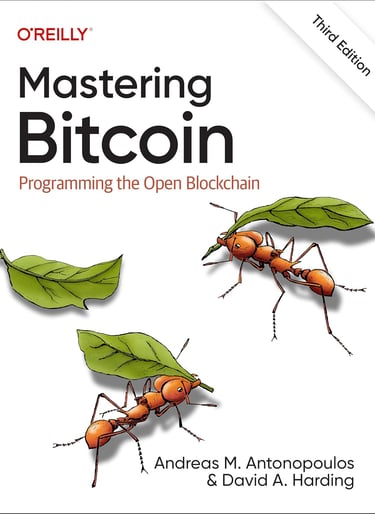
Mastering Bitcoin – Andreas M. Antonopoulos
This is the definitive guide for anyone wanting to understand the intricate workings of the network. Andreas Antonopoulos meticulously dissects Bitcoin's software-level operation. From the mathematical generation of private keys to transaction scripts, including the details of the network communication protocol (P2P), everything is explained with surgical precision.
Why read it? If you're passionate about data frame analysis, communication standards implementation, and raw code, this book is for you. It's aimed at analytical minds who want to understand exactly how cryptographic concepts are coded and integrated into a functional distributed system.

Broken Money – Lyn Alden
Lyn Alden, who has a strong background in engineering, offers a fascinating perspective: she analyzes the evolution of money as an evolution of information technologies and communication networks. The book explains how the current financial system is fundamentally an "obsolete network protocol," limited by the speed of physical transactions and forced to rely on centralized databases (central banks).
Why read it? For its unique perspective on finance seen through the eyes of an engineer. She explains with great clarity how Bitcoin acts as a global upgrade to financial infrastructure, replacing a slow and fallible network with a fast and incorruptible global cryptographic ledger.


The Internet of Money – Andreas Antonopoulos
Unlike Mastering Bitcoin , which is a technical manual, The Internet of Money is a collection of lectures that takes a broader perspective. Antonopoulos draws a striking parallel between the invention of the internet (the decentralized routing of information) and the invention of Bitcoin (the decentralized routing of value). He explains how this new network architecture will revolutionize far more than just the banking sector.
Why read it? To grasp the societal impact of this technology. The book is excellent for understanding how the shift from a client-server architecture (traditional banking) to a robust peer-to-peer architecture will redefine the very notions of trust, digital identity, and sovereignty in the Internet age.


🔎 Related articles :

Tech, simply.
Receive our new articles, tips and comparisons directly in your inbox.
©2026 The Tech BEHIND. All rights reserved
The Tech Behind participates in various affiliate programs. Some links on this site may generate a commission.