


How hackers steal your passwords (without ever guessing them)
Think your strong password is protecting you? Learn how phishing, credential stuffing, and infostealers bypass your security, with recent figures to back it up.
CYBERSECURITY
Lucas GRANDIER
6/12/20265 min read


When we think of hacking, we often imagine a computer genius frantically typing on a keyboard to guess a password, like a Hollywood movie. However, the reality is much more pragmatic.
According to the 2026 edition of the highly respected Verizon Data Breach Investigations Report (DBIR), the exploitation of software vulnerabilities has taken the top spot, establishing itself as the main gateway for hackers with 31% of enterprise compromises.
Hackers would much rather exploit a faulty system or manipulate a user than exhaust themselves breaking into a lock. Let's dive into the real modern techniques of access theft.
1. Phishing, AI and "MFA Fatigue"
2. The "Copy and Paste" Scam: The Clickfix Trap and Infostealers
Phishing is a psychological manipulation attack where the hacker does not hack into your system, but convinces you to give them the keys. By impersonating a trusted third party and creating a false sense of urgency, it pushes you to enter your credentials yourself on a falsified web page.
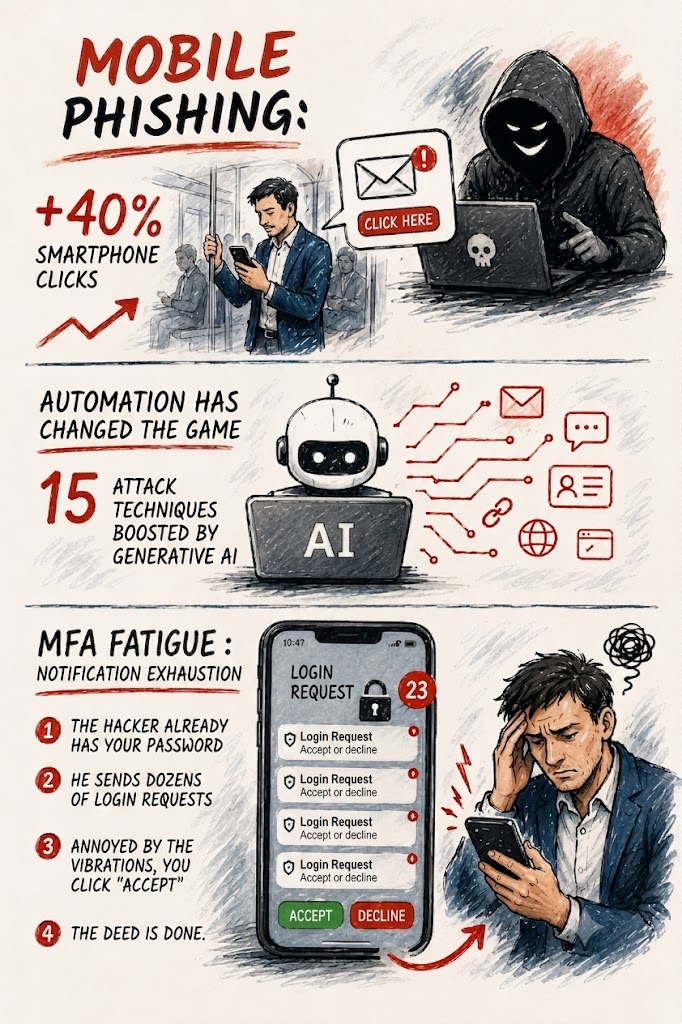
The Verizon report sounds the alarm on mobile: with a 40% increase in the click-through rate on smartphones, hackers have understood that we are much less vigilant in mobile situations (in transport, between two meetings).
In addition, automation has changed the game. According to Verizon, no less than 15 attack techniques are now doped with generative artificial intelligence.
This threat is exacerbated by governance flaws within organizations. According to a global study conducted by IBM and the Ponemon Institute in 2025, the adoption of AI far outpaces the implementation of security and governance rules.
The findings of this report reveal major oversight gaps:
97% of organizations that reported an AI security incident did not have appropriate access controls on these tools.
Ungoverned AI systems are significantly more likely to be hacked, with far greater financial consequences.
Faced with users better protected by two-factor authentication (MFA), hackers invented "MFA Fatigue", a technique that is particularly monitored by the ANSSI in France. The hacker, who already has your password, triggers dozens of connection requests on your phone. Annoyed by the vibrations, you end up clicking "Accept" to have peace. That's it.
This is the new dreadful trend identified by the authorities: pushing the victim to hack into his own computer via the "Clickfix" technique.
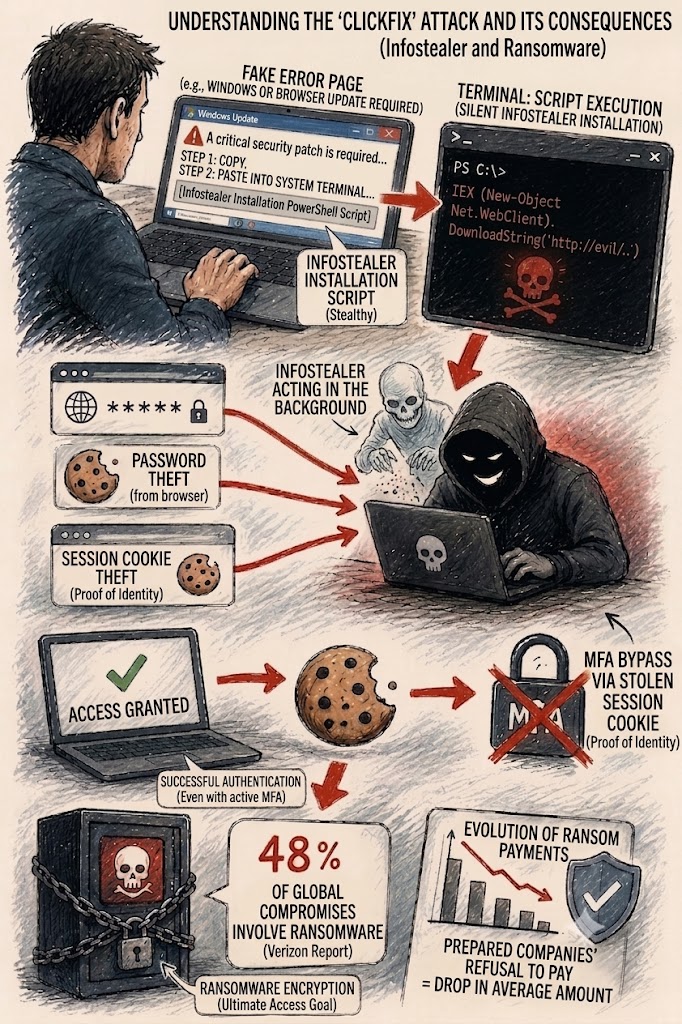
Imagine you're browsing the web and a fake error page (mimicking Windows or your browser) comes up. The message tells you that a fix is needed and asks you to copy a piece of text and then paste it directly into your ordering terminal. If you follow these instructions, you run a script that instantly installs Infostealer, a particularly stealthy data-stealing malware.
This spy will search in the background to steal the passwords saved in your browser, but especially your session cookies. These small files prove to the servers that you have already logged in. By stealing this cookie, the hacker logs in for you and completely bypasses two-factor authentication (MFA).
The purpose of these accesses? The Verizon report recalls that 48% of global compromises involve ransomware. However, this vein is proving to be a little less lucrative: despite the decline in the average ransom amount, prepared companies are increasingly refusing to pay.
3. The second-hand market: Recycling and fake leaks
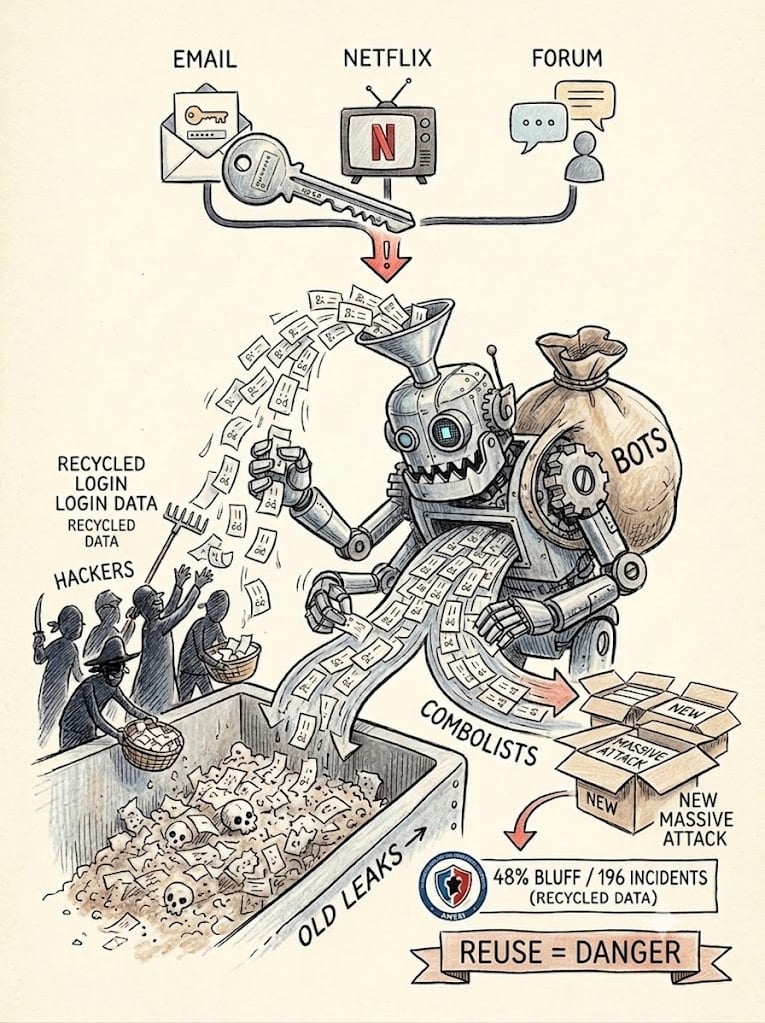
Do you have the same password for your mailbox, your Netflix account, and an old discussion forum? If so, you make the hackers' job much easier.
When an insecure site is hacked, hackers take over the database and use bots to automatically test your credentials on all major sites. This is "Credential Stuffing". Worse still, hackers love to claim claim massive and unprecedented cyberattacks.
In fact, in its latest official report, the ANSSI's Cyber Threat Panorama, the agency points out that it is very often a bluff: cybercriminals simply aggregate and recycle old passwords from past leaks (combolists) to simulate a new hack.
In total, the ANSSI has recorded 196 incidents related to data exfiltration over the year, but reminds us that the main danger lies in the persistent reuse of your old compromised credentials.
How to protect yourself from hackers easily
Use a physical security key
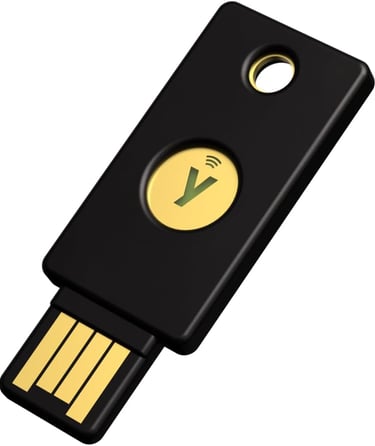
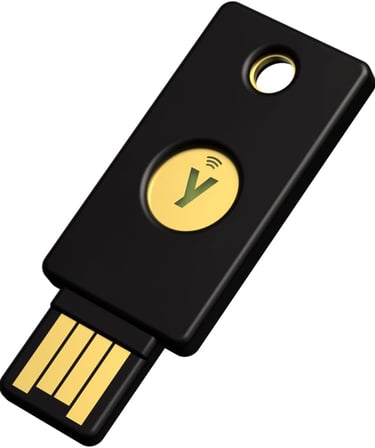
A security key like the YubiKey represents one of the best protections against modern phishing. Unlike a simple code received by SMS or via an application, this key must be physically present to validate a connection.
Even if a hacker knows your password or attempts an MFA Fatigue attack by bombarding your phone with notifications, they won't be able to access your account without that key. It is now the recommended authentication method to protect the most sensitive accounts.
Adopt a password manager
Reusing the same password across multiple sites remains one of the most common mistakes. When a data breach occurs on one service, hackers automatically test the stolen credentials on hundreds of other platforms.
A password manager like Bitwarden or 1Password generates unique and complex passwords for each account. You no longer need to memorize them: the software takes care of them for you while storing them securely.
In conclusion: Equip yourself intelligently in the face of new threats
The race for the most complex password, riddled with capital letters, numbers, and special characters, is definitely a rearguard action. Attackers no longer exhaust themselves guessing your combinations—they circumvent them by exploiting our slumps, leveraging artificial intelligence, and deploying silent malware.
Yet, fighting back doesn't require you to become a cybersecurity expert. As we have just seen, regaining control of one's digital life today requires pragmatic tools that are easy to put in place. By combining a password manager to compartmentalize your access, a hardware key to block phishing outright, and a simple SSD to protect your files from ransomware, you neutralize the vast majority of today's attack vectors.
The goal of this approach is no longer to rely on an infallible memory to remember dozens of complex codes, but to rely on the right technology to make the task of hackers far too difficult and much less profitable.
Back up your data regularly
Ransomware continues to pose a major threat to individuals and businesses alike. Once files are encrypted, it is often impossible to recover them without a backup.
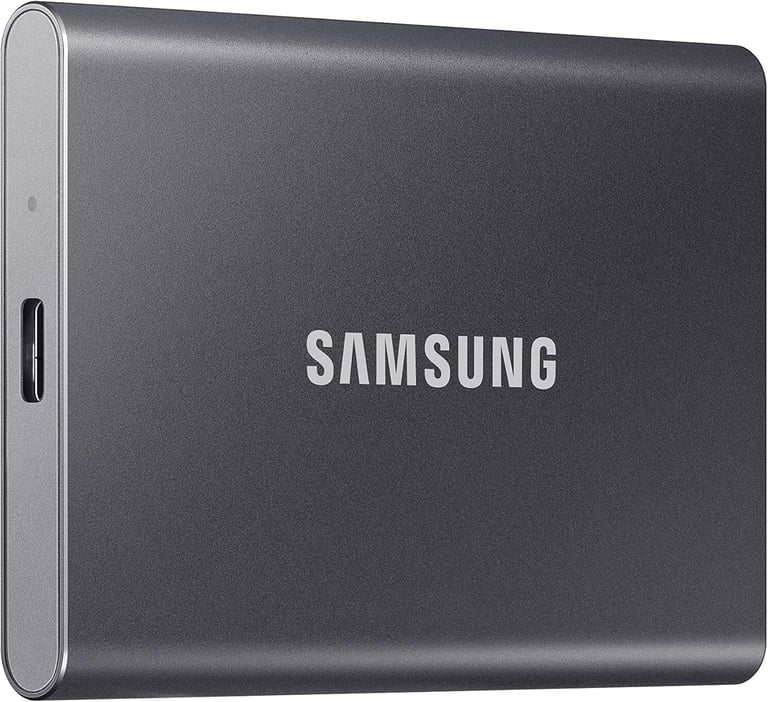
A rugged external SSD like the Samsung T7 Shield allows you to keep a copy of your important documents off the main computer. In the event of an attack, you can restore your data quickly without depending on the requirements of cybercriminals.
Protecting your privacy on a daily basis
Cybersecurity isn't just about passwords. Some simple accessories also help limit digital privacy risks.
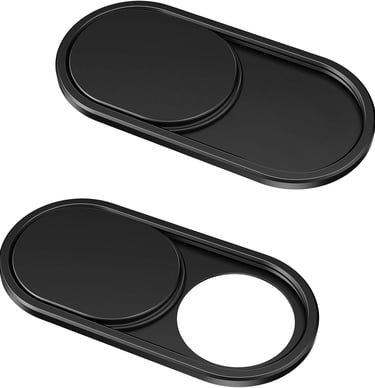
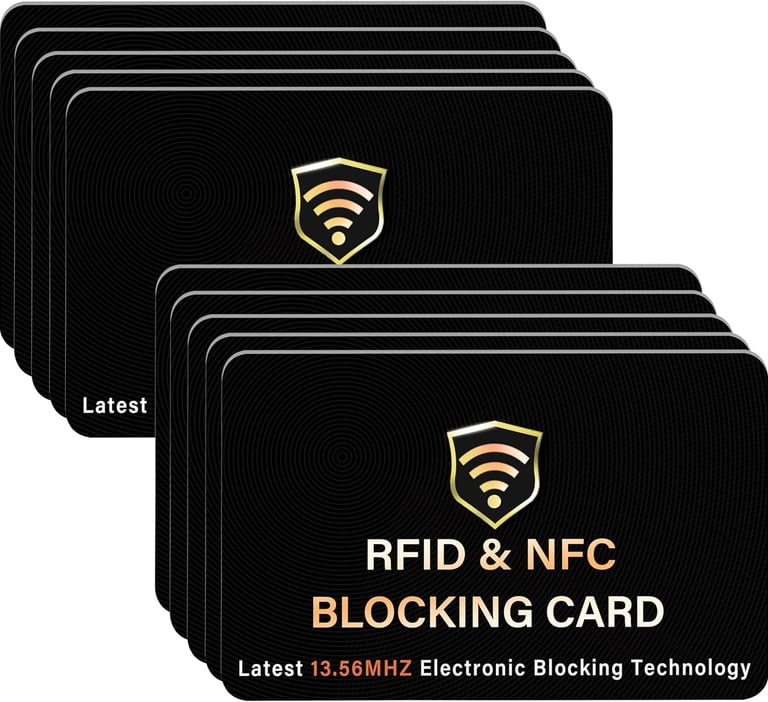
A webcam with a physical cover or an independent webcam shutter prevents malicious camera activation. In the same way, RFID protections can limit some of the risks associated with contactless cards when travelling.
🔎 Related articles :

Subscribe now
Get notified every time an article is published
©2026 The Tech BEHIND. All rights reserved
The Tech Behind participates in various affiliate programs. Some links on this site may generate a commission.