


How do smart scales measure your body fat? The truth about their sensors.
How does a connected scale assess your body fat? Technical deciphering of impedance measurement (BIA), algorithms, limits and 2026 comparison.
ELECTRONICSEVERYDAY TECHNOLOGIES
Lucas GRANDIER
6/20/20266 min read


The integration of on-board electronics into our daily lives has profoundly transformed home healthcare equipment. Today, the connected scale is a standard in many homes. Beyond simple weight, these devices display in a few seconds a complete analysis of your body composition: fat mass, muscle mass, hydration level or bone mass.
However, by what technical processes does a glass platform manage to evaluate this complex physiological data? This article deciphers the technological functioning of these devices, from the acquisition of the bioelectrical signal to the processing of the data, in order to understand their real usefulness and limitations.
1. The Physical Foundation: Bioelectrical Impedance Analysis (BIA)
2. The critical role of the algorithm: From electrical signal to fat mass
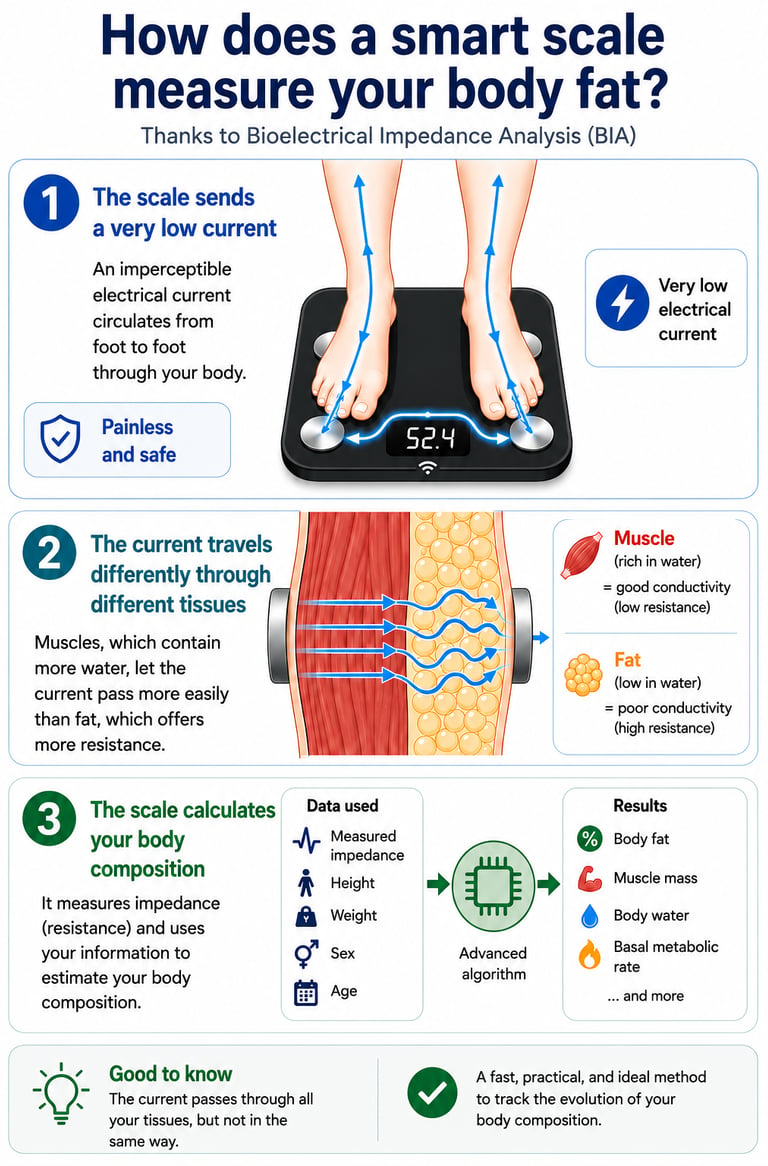
The technology at the heart of almost all consumer connected scales is called Bioelectrical Impedance Analysis (BIA). This process is based on a fundamental physical property: the difference in electrical conductivity of the tissues of the human body.
When you step barefoot on the scale, the electrodes on the surface (often an invisible coating called ITO) inject a very low-intensity, imperceptible and completely painless alternating current. This current travels through your body, usually from one leg to the other as it crosses the pelvis.
The measurement is based on how your tissues respond to this signal:
Lean mass (muscles, organs): These tissues are rich in water (about 70 to 75%) and electrolytes. They are excellent electrical conductors and have very low current resistance.
Adipose tissue (fat mass): Fat cells are low in water (10 to 20%). They act as insulators and considerably slow down the propagation of the electrical signal.
The device will then measure the overall resistance of your body. In electronics, this resistance to the passage of an alternating current is called impedance.
It is essential to understand a major technical point: no connected scale directly measures fat mass. The hardware is limited to quantifying an electrical impedance. Converting this raw data into a body fat percentage is a purely software process.
Once the electrical signal has been retrieved and converted into digital data, the scale's microprocessor relies on mathematical models, called predictive regression equations.
These algorithms have been developed in clinical trials, comparing the electrical resistance of thousands of profiles with reference medical methods (such as the DEXA scanner). However, the value of impedance alone is unusable. In order for the algorithm to estimate your body composition, it must need additional variables:
Size: Essential for assessing the distance travelled by the current.
Weight: Measured instantly by the scale's load cells.
Age and gender: These data statistically influence bone density and the natural distribution of fat tissue.
This is why a rigorous configuration of your user profile is required when using it for the first time. If any of these biometric data are inaccurate, the calculation extrapolated by the algorithm will be mathematically distorted.
3. Measurement variability: Why do the results fluctuate?
Users often notice variations in their body fat content from one day to the next. These fluctuations usually do not reflect sensor failure, but rather the extreme sensitivity of BIA technology to your physiological variations.
The impact of hydration
Impedance is inversely proportional to the amount of water in your body. When you become dehydrated (after intense physical exertion, hot weather, or the consumption of diuretics such as alcohol or coffee), your body's overall electrical resistance increases. The algorithm will automatically and incorrectly interpret this increase in resistance as a sudden increase in your adipose tissue.
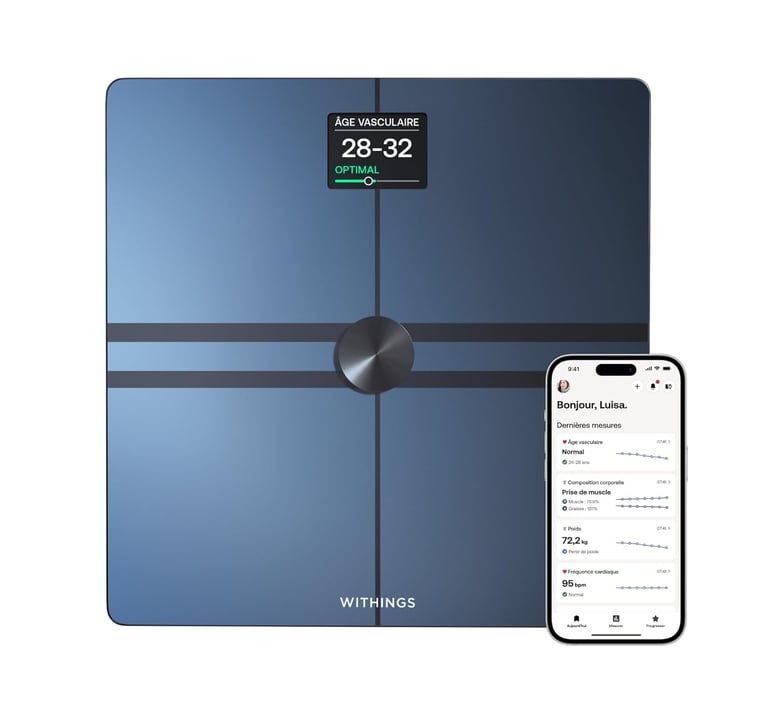
Withings Body Comp: Cutting-edge multi-frequency impedance measurement
The French company Withings has established itself as a benchmark in terms of medical algorithmic rigor. Unlike standard models, the Body Comp uses multi-frequency impedance measurement technology. By injecting several electrical signals at different frequencies, the device manages to differentiate between intracellular and extracellular water. This cross-referencing of data offers much better accuracy in the assessment of fat mass and muscle mass. It also incorporates sensors that assess sweat nerve function (the health of nerves via the electrochemical conductance of the skin).
The ideal profile: Demanding users looking for a comprehensive, clinically validated mapping of their long-term metabolic and cardiovascular health.
Conclusion: An investment in your well-being
The body fat meter balance is a relevant technological digest, provided that you master how it works. By combining the laws of electrical conductivity with the power of algorithmic analysis, it offers a window of observation into your internal metabolism.
Just remember that the number displayed on the screen at a specific time is less important than the dynamics of the curve generated over several months. By adopting a rigorous measurement protocol, you turn this device into a real dashboard of your body composition.
Skin contact impedance
The quality of the contact between your arches and the electrodes is decisive. Hyperkeratosis (large presence of horns) or excessively dry skin modifies the surface impedance, which interferes with the acquisition of the electrical signal and biases the final calculation.
Morphological extrapolation
Standard scales use a bipolar circuit (from one foot to the other). Since the electric current always takes the path of least resistance, it only passes through the lower body. The algorithm estimates the composition of your lower extremities and uses statistical models to infer the composition of your upper body. For people with an atypical fat distribution, this extrapolation reduces the absolute accuracy of the result.
4. Equipment Guide 2026: Hardware Solutions Comparison
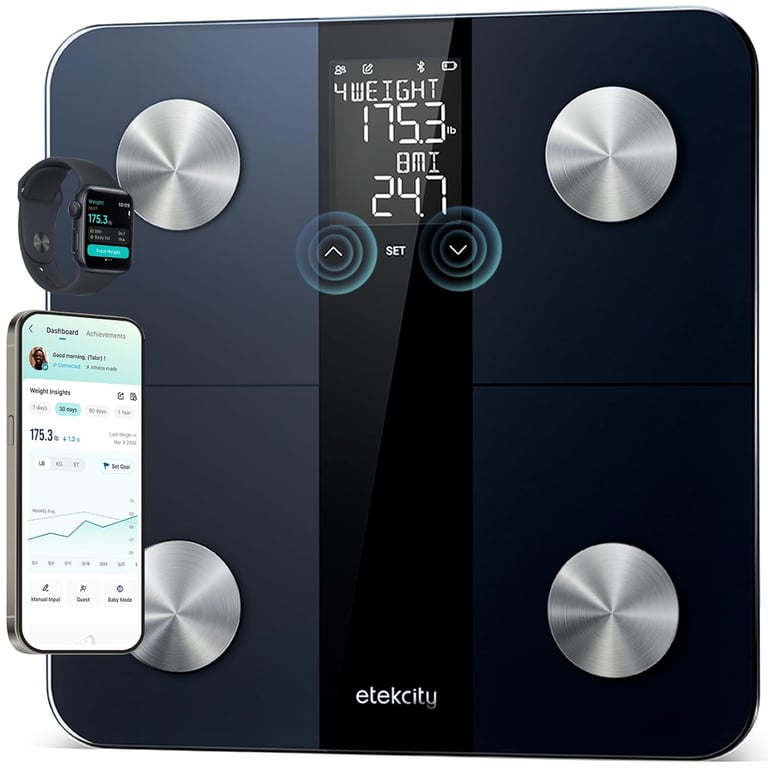
Etekcity Upgraded Smart Scale: Affordable Dual-Frequency Technology
In the affordable segment, the Etekcity brand stands out by incorporating dual-frequency electronic architecture (dual-frequency electrode technology). This is a rare technical feature at this price point, enabling a much more precise assessment of the 13 body metrics measured (body fat, muscle mass, BMI, etc.). On the software side, the VeSync app acts as a central hub, capable of instantly syncing your data to third-party reference platforms. Finally, a physical switch on the back of the device allows you to activate offline mode: the scale then uses its own memory to store over 600 weigh-ins independently.
The ideal profile: People who want truly reliable results and a scale that syncs easily with their favorite fitness apps (Apple Health, Google Fit, Fitbit...), all at an affordable price. Great convenience for everyday use: being able to weigh yourself first thing in the morning without having to look for your phone, since the scale takes care of saving the data for later.
5. Weighing Protocol: How to Neutralize Margins of Error
The connected scale should be considered as a tool for analyzing trends rather than as an absolute measurement instrument. To take advantage of its algorithms, you need to standardize your weighing conditions to provide the microcontroller with basic data that is comparable from one session to the next.
Measured frequency: Space out the measurements to once a week to avoid the statistical noise of daily water variations.
Physiological constancy: Weigh when you wake up, on an empty stomach, and after urination. This ensures a relatively stable level of bodily fluids.
Conductivity optimization: Make sure the plantar surface is clean and very slightly moist (natural moisture after showering, when wiped off, provides optimal conductivity for the electrodes).
By isolating these environmental variables, the variations detected by the system will reflect in a much more relevant way the real evolution of your metabolism and your muscle and fat tissue.
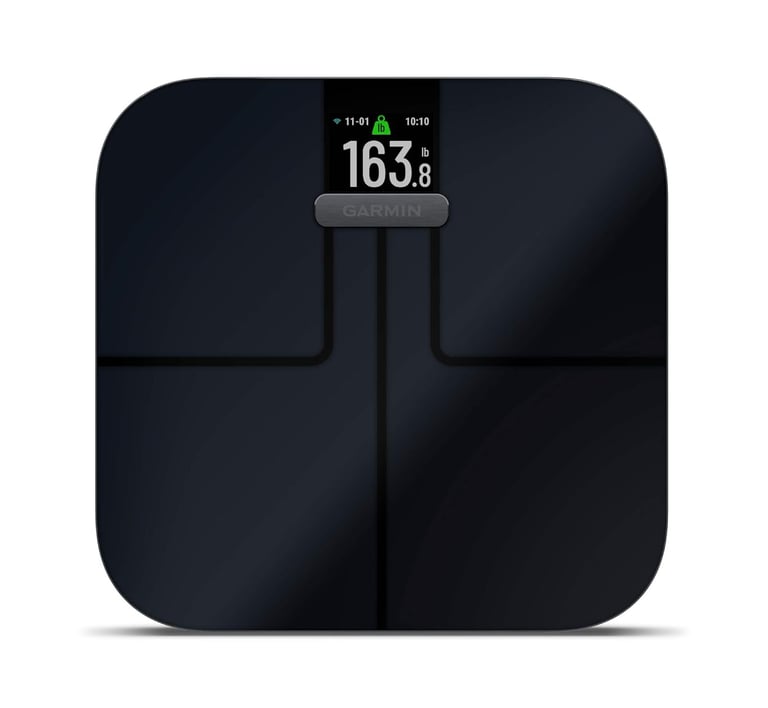
Garmin Index S2: Calibration calibrated for athletic physiology
The limit of impedance measurement often lies in so-called "atypical" profiles. An endurance athlete or a practitioner of muscle hypertrophy has bone density and intramuscular water retention that are very different from average. Garmin has specifically adjusted its regression equations to compensate for these morphological biases. On the hardware side, the built-in Wi-Fi connectivity ensures direct, encrypted transmission of raw data to the Garmin Connect ecosystem, without the need to open a third-party smartphone app.
The ideal profile: Regular athletes, especially those already in the Garmin hardware ecosystem, who want to correlate variations in their body composition with their training loads.
🔎 Related articles :

Tech, simply.
Receive our new articles, tips and comparisons directly in your inbox.
©2026 The Tech BEHIND. All rights reserved
The Tech Behind participates in various affiliate programs. Some links on this site may generate a commission.